Publication Date: November 12, 2026
Access counts:0
Multiplexing of Nuclear Spin State by Mechanical Rotation
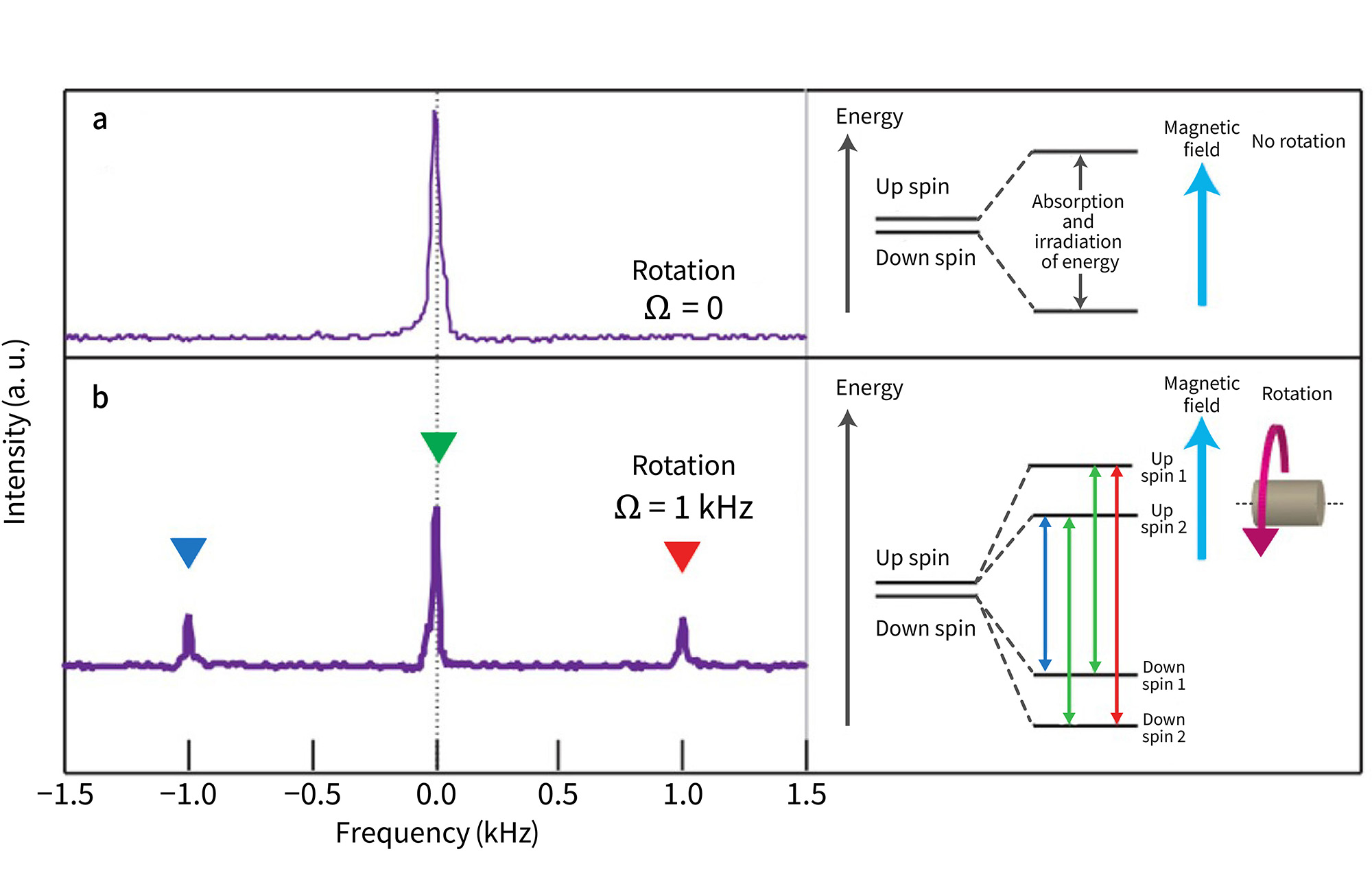
Fig. 1 Rotation-induced splitting of NMR spectra
Normally, a spin-1/2 nucleus has two quantum states in a magnetic field, giving rise to a single resonance line in nuclear magnetic resonance (NMR) (Fig. 1a). In this study, we developed a unique NMR apparatus in which both the sample and the detection coil rotate simultaneously at high speed, allowing us to investigate nuclear spin dynamics in a mechanically rotating frame of reference. Surprisingly, we discovered that the NMR spectrum of spin-1/2 fluorine nuclei splits into three resonance lines as shown in Fig. 1b.
The splitting between the resonance lines corresponds to the mechanical rotation frequency and remains independent of the angle between the rotation axis and the external magnetic field, whereas the intensities of the individual resonance lines exhibit a characteristic angular dependence. To understand this unusual phenomenon, we performed a theoretical analysis based on Floquet theory, which describes quantum systems subjected to periodic time-dependent driving. The analysis revealed that, in addition to the intrinsic nuclear spin-1/2, an additional effective spin-1/2 degree of freedom emerges from the periodicity of mechanical rotation. A single nuclear spin can be described by four quantum states instead of the original two state. These two spin-1/2 degrees of freedom can be treated as two qubits, and our theoretical analysis suggests that quantum logic operations can be performed using this system.
This study establishes a new principle for expanding the quantum-state space through classical mechanical rotation, opening up new possibilities for quantum information processing. As a next step, we aim to experimentally demonstrate quantum logic operations based on this principle.

Comments on This Article
Share your comments or feedback on this article using the comment form.