JAEA R&D Navigator
Top  >  R&D for Restoring the Environment in Fukushima  >  To What Extent Can Human Activities Reduce Ambient Dose Rates?

Publication Date: November 19, 2026

Access counts:0

categ9

To What Extent Can Human Activities Reduce Ambient Dose Rates?
-Evaluation of Dose-Rate Reduction Due to Vehicular Traffic Using Three-Dimensional Simulation-
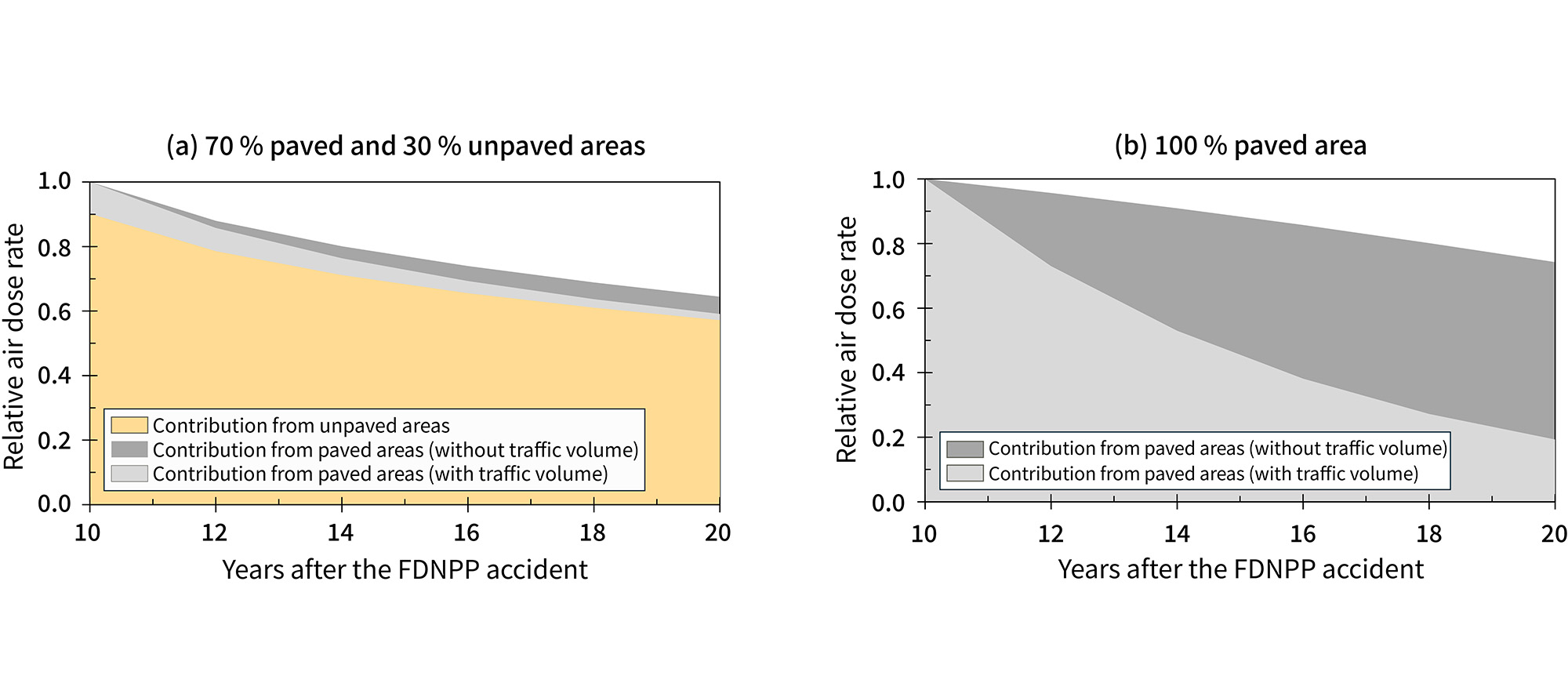
Fig. 1  Effects of the proportion of paved surfaces and traffic volume on the reduction in ambient dose rates

Fig. 1  Effects of the proportion of paved surfaces and traffic volume on the reduction in ambient dose rates


Based on the relationship between traffic volume and residual radiocesium obtained from on-site measurements, the decrease in radiocesium on paved surfaces due to vehicular traffic was modeled as a function of traffic volume. Under the condition of 70 % paved and 30 % unpaved surfaces, the large contribution from unpaved surfaces limited the reduction in ambient dose rates attributable to vehicular traffic. In contrast, under the condition of 100 % paved surfaces, the effect of vehicular traffic was directly reflected in ambient dose rates. Twenty years after the accident, an additional reduction of up to approximately 50 % was predicted compared with the corresponding scenario without vehicular traffic.

Following the accident at TEPCO’s Fukushima Daiichi Nuclear Power Station (FDNPS), ambient dose rates in the surrounding areas have gradually decreased. However, the effects of human activities other than decontamination have not been sufficiently evaluated. Therefore, traffic volume and residual radiocesium on paved surfaces were investigated in areas surrounding the FDNPS. The results showed that areas with higher traffic volumes tended to have lower amounts of residual radiocesium.

This relationship was incorporated into 3D-ADRES (3D-Air Dose Rate Evaluation System), a three-dimensional environmental modeling tool developed by our research team. Monte Carlo simulations were then performed using PHITS (Particle and Heavy Ion Transport code System), a general-purpose radiation transport simulation code.

The results suggested that higher traffic volumes led to greater reductions in residual radiocesium on paved surfaces, thereby further reducing ambient dose rates (Fig. 1). These findings highlight the importance of considering not only land-use conditions but also the effects of human activities when predicting future ambient dose rates.

Acknowledgements
The authors sincerely thank the residents and local government officials for their considerable cooperation during the environmental surveys conducted in Okuma Town, Fukushima Prefecture. This study includes results obtained through the FY2022 Research Project on the Health Effects of Radiation, supported by the Ministry of the Environment Government of Japan, for which Kazuya Yoshimura served as the principal investigator.
Author (Researcher) Information
Reference
Kim, M. et al., Effects of Non-Decontamination Human Activities on the Reduction of Ambient Dose Equivalent Rates in Residential Areas Near the Fukushima Daiichi Nuclear Power Plant. Journal of Environmental Radioactivity, vol.294, 2026, 107931, 8p.
Paper URL: https://doi.org/10.1016/j.jenvrad.2026.107931

Comments on This Article

Share your comments or feedback on this article using the comment form.

Back to Top