|
||
|
 |
||
|
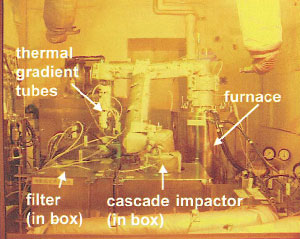
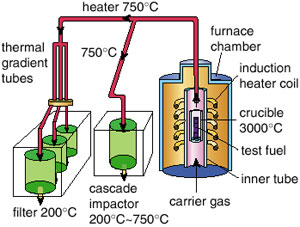
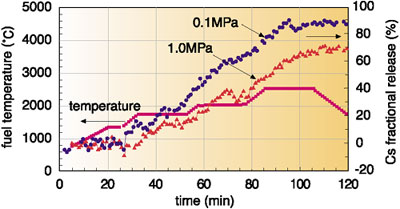
| As part of the research to confirm LWR safety, an experimental study is being performed using the VEGA facility, shown in Fig. 1-4, to investigate the behavior of radionuclides released from irradiated fuel in a reactor core under very high temperature conditions, above the melting point of the fuel (about 2,800 degrees cent.). Radionuclides accumulate inside LWR fuel as fuel burnup progresses. Therefore, LWRs have been designed and operated so that a radionuclide release to the environment would be as small as possible if there were a severe accident. However, it is an important issue for reactor safety to understand well the release behavior of radionuclides. To date, extensive worldwide research has been performed and many radionuclide release phenomena have been clarified. However, the release behavior at high temperatures, above the fuel melting point, or at high-pressure conditions has not yet been investigated due to the difficulty in experimentally obtaining these conditions. In the VEGA tests, radionuclides released from fuel into high temperature steam, up to 3,000 degrees cent., at elevated pressures, up to 1.0 MPa, are being investigated using ThO2 structures as furnace materials. In particular, the release behaviors of short-life and low-volatility actinide nuclides will be clarified. This facility is unique in the world and has special features to allow investigation of the effects of pressure on radionuclide releases. Experimental studies were initiated in FY1999, and three tests, partly to confirm facility capabilities, have been performed to date. The second test was the first in the world to be conducted at the elevated pressure of 1.0 MPa. This test determined, as shown in Fig. 1-5, that the Cs release rate was about 20% less than that at atmospheric pressure, 0.1 MPa. This may result from the release of Cs from the fuel in two diffusion steps, 1) diffusion in the solid UO2 grains, and 2) diffusion in the open pores of the UO2 pellets. The mechanism of this phenomenon will be investigated in the future. Systematic research during the next five years will investigate the radionuclide release from fuel during severe accidents by heating test fuel including MOX to 3,000 degrees cent. in various ambient gas species. The results obtained will be used for clarification of release mechanisms and precise evaluation of the source term. |
| Reference T. Kudo et al., Influence of Pressure on Cesium Release from Irradiated Fuel at Temperatures up to 2773 K, J. Nucl. Sci. Technol., 38(10), 910 (2001). |
| Select a topic in left column |  |
| Persistent Quest - Research Activities 2001 Copyright(c) Japan Atomic Energy Research Institute |