In the event of a criticality accident, high radiation doses from both neutrons and g-rays are often fatal to workers. For emergency medical care for radiation exposure, it is urgent that the doses absorbed by each worker be evaluated quickly.
Experimental studies have been conducted in several countries to evaluate personal-exposure doses during criticality accidents. In these studies, activation foils and tablets, such as gold, copper, indium, and sulfur, were used to measure neutron doses. However, this method requires complicated calculations to convert measured activities into absorbed doses. It is often accompanied, therefore, by significant uncertainties.
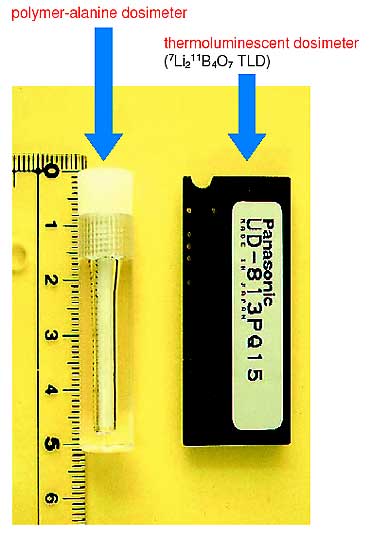
Hence, this easy measurement method was developed using two tissue equivalent dosimeters, a polymer-alanine dosimeter and a 7Li211B4O7-thermoluminesent dosimeter (TLD). The polymer-alanine dosimeter, which has been developed under the collaboration of JAERI and Hitachi Cable Ltd., is sensitive to both neutrons and gamma-rays, while the 7Li211B4O7 TLD is sensitive to gamma-rays but not to neutrons. Since the gamma-ray sensitivity of the TLD is close to that of the polymer-alanine dosimeter, the neutron absorbed dose can be directly obtained by subtracting the dose measured by the TLD from that measured by the polymer-alanine dosimeter.
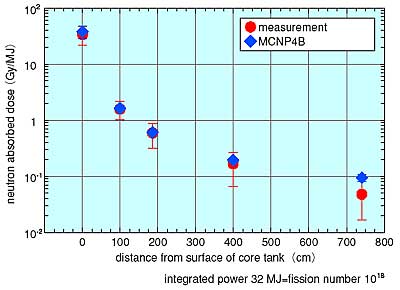
To verify the accuracy of this method, experimental studies were performed in a radiation field under criticality accident conditions at the Transient Experiment Critical Facility (TRACY). The experimental results confirmed that neutron absorbed doses could be evaluated in the range of 0.5 to 700 Gy, and these doses were consistent with the doses calculated by the continuous-energy Monte Carlo Calculation Code (MCNP4B) (Fig. 1-3). These lightweight and the small-size dosimeters are suitable for use as individual radiation monitors in a criticality accident (Fig. 1-2). |