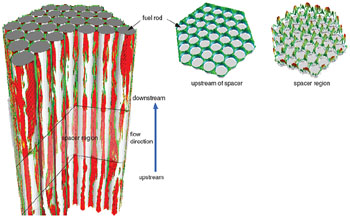
To predict the complex two-phase flow behavior in nuclear reactors with high accuracy, development of an advanced thermal design method with large-scale simulations is underway. In case of the conventional thermal design method, composition equations and empirical correlations based on many experimental data are required. When insufficient experimental data are available, highly precise predictions are uncertain. As a result, the advanced thermal design method by simulations only was proposed. By combining computational science with conventional thermal design method, the two-phase thermal-hydraulic phenomena in which experimental verification is lacking can be grasped correctly and improvements in conventional prediction accuracy of core design parameters, critical heat flux, void fraction, etc., are expected. Moreover, shortening of developmental periods and reduction of costs are also expected.
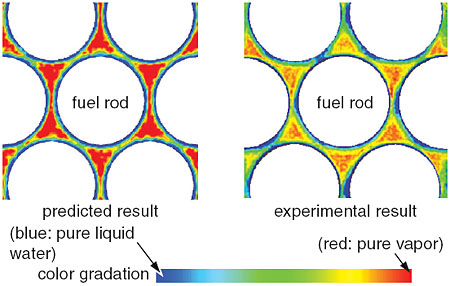
This advanced thermal design method has already been used in the design study of an innovative nuclear reactor. Large-scale two-phase flow simulations are carried out under a tight-lattice fuel bundle condition. The predicted results are shown in Figs. 1-4, 1-5 and 1-6. The Earth Simulator, which is one of the most powerful computers in the world, is used in the present large-scale simulations. A calculation having a maximum of 100 nodes, 2 terabytes and 300 million mesh divisions was achieved. From a series of predicted results, the three-dimensional two-phase flow structure between liquid water and vapor in nuclear reactors was clarified quantitatively. Development of a new two-phase flow analysis code, a high precision visualization method, and three-dimensional thermal-hydraulic measurement technology is also proceeding. The advanced thermal design method for nuclear reactors will be completed in the near future.
|