| When solid material is irradiated by some kinds of radiation,
the quality of the material is sometimes degraded considerably
(radiation damage). An understanding of the mechanism of radiation
damage is important for the development of useful materials. When
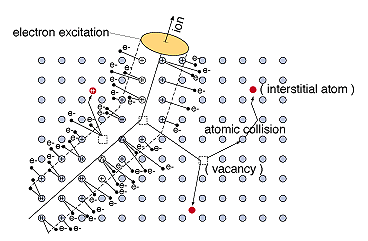
a high energy ion is injected into the lattice of a metal crystal,
it passes through the lattice exciting electrons near the ion
orbit and transfering the ion energy to them, or the ion directly
collides with an atom of the lattice. In the latter case, the
atom is ejected from the lattice. The ejected atom collides with
another atom and the process is repeated. The defects of interstitial
atoms and vacancies are produced as a cascade (Fig. 1-3). To know
which of these processes is dominant is very important and up
until now it was believed that radiation damage in metals is explained
by the direct collision of atoms. However, in experiments for
Ni, Pt, and so on at an extremely low temperature (-265 degrees
cent.) where the movement of defects is frozen, we found that
the effect of electron excitation dominates. This is clearly shown
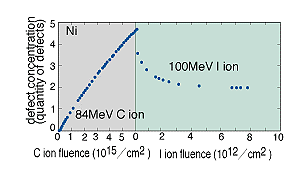
in the experiment of the irradiation of Ni crystal by carbon and
iodine ions sequentially as follows; (1) by irradiating the Ni
crystal with C ions, Ni atoms are ejected from the lattice but
their movement is frozen because of the extremely low temperature,
which results in the accumulation of defects with time (Fig. 1-4
left), but (2) if after the irradiation by C ions, the crystal
is irradiated by iodine ions which have a higher electron excitation
effect than carbon, the energy of the iodine ions effectively
diminishes the defects and the number of the defects decreases
quickly. Thus, to decrease the defects, only a small amount of
an irradiation with iodine ions suffices because of their high
electron excitation effects (Fig. 1-4 right). |