| On the earth there exist 90 elements, from hydrogen with the atomic
number 1, to uranium with atomic number 92, with the exception
of the 43rd element, technetium, and the 61st element, prometium.
Most of the radioactive elements among them were discovered during
the first half of this century, and up to now all the elements
to the 109th have been discovered or synthesized, including the
43rd and 61st. For the syntheses of new elements, various nuclear
reactions are utilized, and to detect a very small amount of reaction
products, various sophisticated methods or devices are used. It
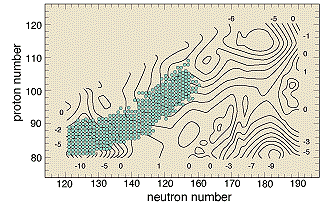
is very interesting to know how large atoms can be synthesized.
This question can be answered by investigating the atoms located
in a valley of the nuclear shell structure energy (Fig. 1-7).
A nucleus is composed of protons and neutrons, and when the numbers
of protons and neutrons coincide with special numbers called magic
numbers, the nucleus is extremely stable which is the result of
the theory of nuclear shell structure. The next undiscovered or
unsynsthesized atom with magic numbers is the atom with 114 protons
and 178 neutrons. At these magic numbers the shell structure energy
is a minimum and this is where it is believed that a new element
can be synthesized. Research is being carried out to discover
such an element. This type of research is important not only because
we can discover unknown elements but also because it is a stringent
test as to whether our knowledge of nuclear physics is valid even
in extreme conditions. |