 |
||
|
 |
||
|
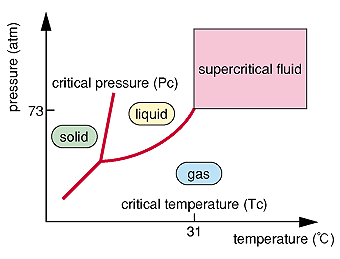
| When both temperature and pressure of a gas are raised above its
critical values (Tc and Pc), it becomes a supercritical fluid,
SF (Fig. 1-2). The fluid has various attractive properties of
solvent power, diffusibility, mass transfer and others, compared
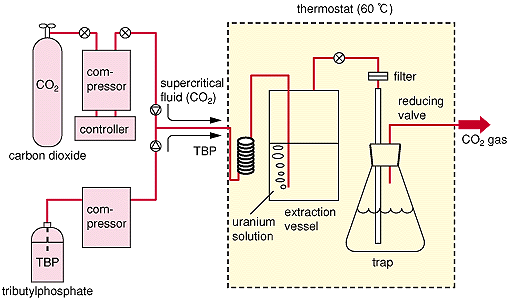
to the ordinal simple state, of gas or liquid. Thus, SF can provide various research subjects not only scientifically but also technologically. Supercritical fluid extraction (SFE) offers several advantages over conventional extraction, such as liquid-to-liquid and solid-to-liquid extraction. Here particular attention is placed on the recovery of uranium and transuranium elements from various waste solutions using carbon dioxide because of its moderate critical constants (Tc=31 degrees cent., Pc=73 atm), inertness, and availability in purified form. The process prevailing at present for the uranium extraction is the tri-n-butylphosphate extraction (Purex process), where a large amount of waste of used organic solvents is generated. This is one of the significant drawbacks of the process. The experiments on SFE, however, clearly demonstrate the advantage of easy recovery of the gas simply by reducing its pressure to atmospheric pressure after the extraction process (Fig. 1-3). In addition to this, satisfactory extractability has been confirmed. Because the special advantage of SFE is applicable to the separation process handling of large amounts of radioactive materials, extensive research on the wide spectrum concerning SFE are progressing toward its incorporation to the reprocessing of spent fuels. |
| Reference
S. Iso et al., Extraction of Uranium (IV) from Nitric Acid Solution into Supercritical Carbon Dioxide Containing Tri-n-butylphosphate, Chem. Lett., 1995 (5), 365 (1995). |
| Select a topic in left column |  |
|
Persistent Quest-Research Activities 1996 Copyright(c)Japan Atomic Energy Research Institute |