|
||
|
| Orbitals of electrons in an atom or molecule are divided into
two categories. First is the inner-shell orbital which does not
participate in the chemical bond. The second is the valence orbital
which directly takes charge of the chemical bond. When an atom
or molecule is irradiated with visible light or ultraviolet rays,
electrons in valence orbitals are excited. As a result some specific
chemical reaction occurs. This is a so-called photochemical reaction.
We are studying the possibility controlling photochemical reactions
by exciting electrons in inner-shell orbitals. For this purpose,
we have used energy-tunable synchrotron x-rays with high energy
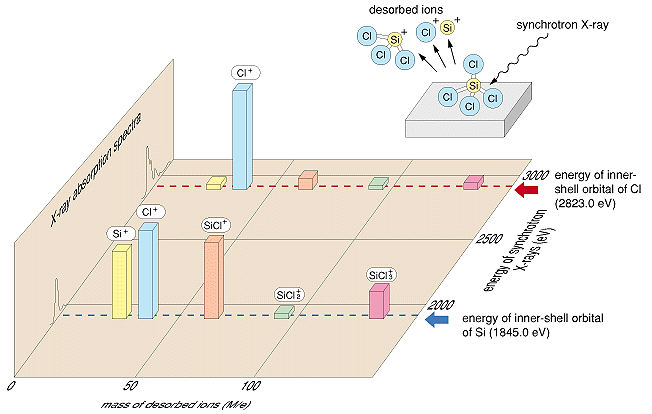
resolution (1/2000). The upper figure shows the desorbed ions from the surface of solid tetrachlorosilane (SiCl4) irradiated with synchrotron x-rays. When the energy of x-rays is tuned at the energy of the inner-shell orbital of chlorine (on the red dotted line) most of the desorbed species are Cl+ ions. This is appreciably different from the desorption pattern by the inner-shell excitation at the silicon site (on the blue dotted line). This phenomenon is interpreted by the selective photoexcitation only at the chlorine site, because the energy of the inner-shell orbital is specific to the element. We were able to find several similar examples in which element-specific photochemical reactions occur with the use of synchrotron x-rays. Namely, we can say that synchrotron x-rays are capable "scissors" to cut a specific chemical bond. |
| Reference
Y. Baba et al., Photon-stimulated Ion Desorption from Condensed SiCl4 by Resonant Excitation at the K-edges, Surface Sci., 341, 190 (1995). |
| Select a topic in left column |  |
|
Persistent Quest-Research Activities 1996 Copyright(c)Japan Atomic Energy Research Institute |