 |
||
|
 |
||
|
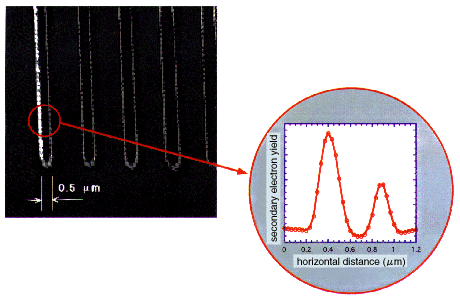
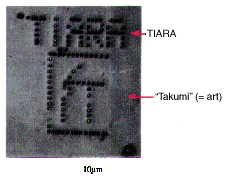
| JAERI succeeded in producing a 2 MeV helium ion beam of 0.4 micrometer
x 0.4 micrometer in size and 77 pA (picoampere = 10-12 A) in intensity. By further R&D a 2 MeV helium beam (0.19 micrometer
x 0.26 micrometer, 15 pA) and a 2 MeV proton beam (0.18 micrometer
x 0.22 micrometer, 1 pA) were obtained. This was the first in
the world as a micro ion beam of pA and 0.2 micrometer level,
although there exist MeV beams of fA (femtoampere = 10-15 A) and 0.1 micrometer level. For an application of the intense and fine beams, JAERI is starting the development of a micro PIXE (particle induced x-ray emission) camera which can analyze distributions of metallic elements like zinc in biological cells. It has recently been recognized that these elements correlate with health conditions. The beams will also be applied for studies on local deactivation of bio cells, in which the size of the chromosome corresponds to 0.2 micrometer, and on malfunction of local parts in semiconductor devices induced by cosmic rays. |
| Reference
T. Kamiya et al., Submicron Microbeam Apparatus using a Single-ended Accelerator with Very High Voltage Stability, Nucl. Instrum. Methods Phys. Res., Sect. B 104, 43 (1995). |
| Select a topic in left column |  |
|
Persistent Quest-Research Activities 1996 Copyright(c)Japan Atomic Energy Research Institute |