 |
||
|
 |
||
|
| The high resolution measurement of x-ray energy spectrums is a
very important technology in various fields. Usually an x-ray
energy spectrum is found by measuring the electric current carried
by free electric charges which are liberated by x-rays in the
detector. If the free electric charges can somehow be produced
by a smaller amount of energy, then we can expect to measure the
x-ray energy with higher resolution. After the semiconductor detector
was developed the energy resolution of x-ray measurements was
improved by one order of magnitude compared to the previous techniques.
In semiconductor detectors, the free electric charges are electrons
and vacancies. In a superconductor, on the other hand, free electric
charges can be produced by splitting the Cooper pairs using an
energy several thousand times smaller than that necessary for
the semiconductor (Fig. 1-5), so x-ray energy measurements with
much higher resolution are expected. This kind of detector has
been realized by using a superconducting tunnel junction (STJ)
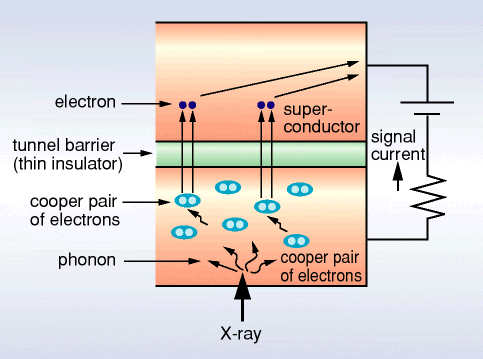
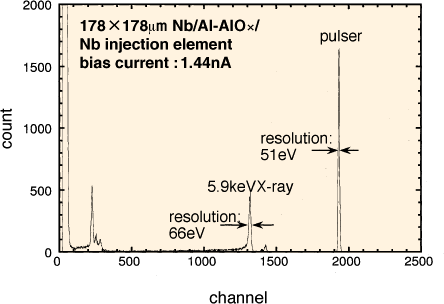
element composed of two superconductors separated by a thin insulator. The theoretical limit of the resolution of the semiconductor detector is about 100 eV. Statistical fluctuations limit the resolution of the STJ detector, so we cannot attain several thousandths of this value as the resolution of the STJ, but it is theoretically expected that a resolution of several tenths of the above value (less than several eV) can be attained. We designed and constructed an STJ detector, optimizing the choice of amplifier and the operating conditions so that it had low voltage noise. The best energy resolution obtained with this system was 66 eV, using a Nb-based STJ detector system (the former best value was 88 eV) (Fig. 1-6). Because this resolution is still poor compared to the theoretical resolution, we are making efforts to produce a better system by studying the x-ray detecting characteristics and the proportionality between the output value from the detector and the radiation energy. |
| Reference
K. Kishimoto et al., High Resolution x-ray Detector by Nb-based STJ and 4-JFETs Low Noise Amplifier, Nucl. Instrum. Methods Phys. Res., A370, 126 (1996). |
| Select a topic in left column |  |
|
Persistent Quest-Research Activities 1997 Copyright(c)Japan Atomic Energy Research Institute |