It had once been considered that magnetism and superconductivity are
not compatible with each other and, as a result, magnetic metals do
not exhibit superconductivity. Later, however, heavy fermion superconductors
were found, in which magnetism and superconductivity coexist. And now,
the interplay of magnetism and superconductivity is one of the major
issues in solid state physics.
A uranium compound, UPd2Al3, is one of the most typical heavy fermion
supercon-ductors. UPd2Al3 exhibits antiferromagnetic ordering below
the Neel temperature TN=14.5 K. Superconductivity occurs below the superconducting
transition temperature Tc=1.95 K, where magnetism and super-conductivity
coexist. Most of the previous neutron and magnetic X-ray scattering
studies, however, have yielded no evidence of the interplay between
magnetism and superconductivity in UPd2Al3. Therefore, magnetism and
superconductivity have been believed to be independent in this material.
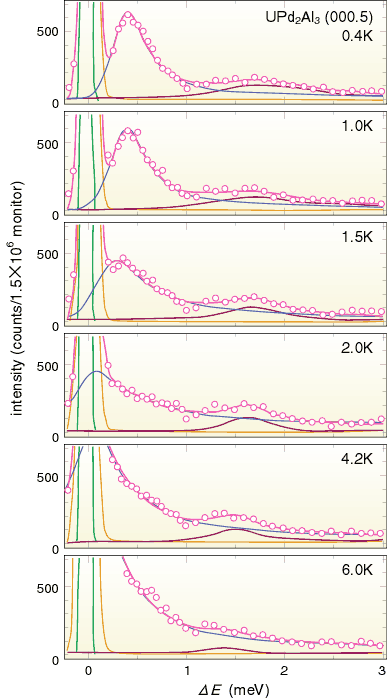
We had a particular interest in this material and performed a high-resolution
neutron scattering experiment. The accuracy of the scattering intensity
measurements was 0.1%, an order of magnitude better than previous ones.
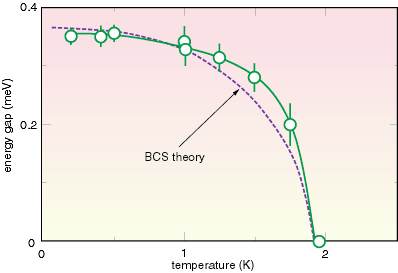
In addition, the sample was cooled to 0.3 K, far below Tc. As a result,
we succeeded in observing an inelastic scattering peak with the excitation
energy corresponding to the superconductivity gap at temperatures below
Tc (Fig. 1-7). This is clear, direct evidence that magnetism and supercon-ductivity
are strongly coupled in UPd2Al3 and is the first discovery in heavy
fermion superconductors. The present results as well as a series of
our other experimental results have shown that the superconductivity
of this material is of magnetic origin. |