 A Very Weak Interaction Controls Chemical Reaction A Very Weak Interaction Controls Chemical Reaction
 |
||
|
 |
||
|
| Atoms and molecules condense at low temperatures through various
kinds of attraction forces operative between all atoms and molecules
when they are close together. Among them, the Van der Waals force,
which is quite weak, occurs as the result of correlated motions
of electrons in the adjacent atoms and molecules. We investigated
theoretically the role of the Van der Waals force in chemical
reactions and predicted an occurrence of a new type of laser induced
chemical reaction. For the F + H2  HF + H reaction, which is important in understanding reaction
dynamics, many researchers have calculated probabilities for the
reaction at various energies of the reacting system using the
potential energy surface obtained by ab initio M.O. methods. It is noted that the reacting system, having energy
less than the potential barrier, can react through the quantum
mechanical H-atom tunneling phenomenon. However we are the first
to consider the weak Van der Waals interaction in this calculation
and to study in detail quasibound states localized in the reactant
and product Van der Waals regions, i.e. (F...H2) and (HF...H) formed at the entrance and exit of the potential
energy surface, respectively. HF + H reaction, which is important in understanding reaction
dynamics, many researchers have calculated probabilities for the
reaction at various energies of the reacting system using the
potential energy surface obtained by ab initio M.O. methods. It is noted that the reacting system, having energy
less than the potential barrier, can react through the quantum
mechanical H-atom tunneling phenomenon. However we are the first
to consider the weak Van der Waals interaction in this calculation
and to study in detail quasibound states localized in the reactant
and product Van der Waals regions, i.e. (F...H2) and (HF...H) formed at the entrance and exit of the potential
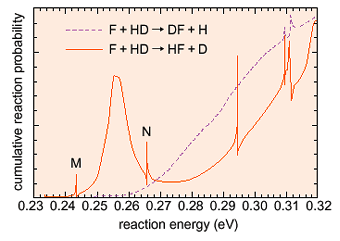
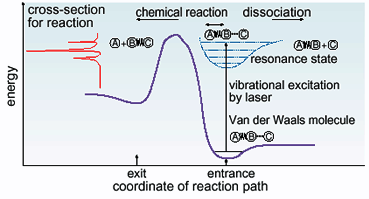
energy surface, respectively. Interestingly, we found that, when the energy levels of the reacting system (F + H2, D2 and HD) coincide with levels of the quasibound states, quantum interference effects play a decisive role in determining reaction probabilities (Fig. 1-1). The quasibound states include many internal states originating from rotational, vibrational and electronic states of each molecule, and if each state occurs in the tunneling region, having a dissociation channel into the stable product, it easily undergoes line-broadening, and consequently significant interference. This phenomenon can be applied to control chemical reaction (Fig. 1-2). Van der Waals complexes of the type AB(ground state)...C may be prepared for example, in a molecular beam, and excited by an appropriate laser to yield AB(excited)...C. This may lead to dissociation into A + BC with an extremely high probability due to the interference effect with tunneling. Thus, DF(deuterium fluoride) may be selectively separated from a mixture of H2, HD, and D2. |
| Reference
T. Takayanagi et al., Van der Waals Resonances in Cumulative Reaction Probabilities for the F + H2, D2, and HD Reactions, J. Chem. Phys., 109(20), 8929 (1998). |
| Select a topic in left column | 
|
|
Persistent Quest-Research Activities 1999 Copyright(c)Japan Atomic Energy Research Institute |