Publication Date: February 6, 2026
Access counts:0
Prediction of Solution Composition Under High-Temperature and Strong-Acid Conditions in the IS Process
-Development of an Online Composition Prediction Method Using a Deep Neural Network-
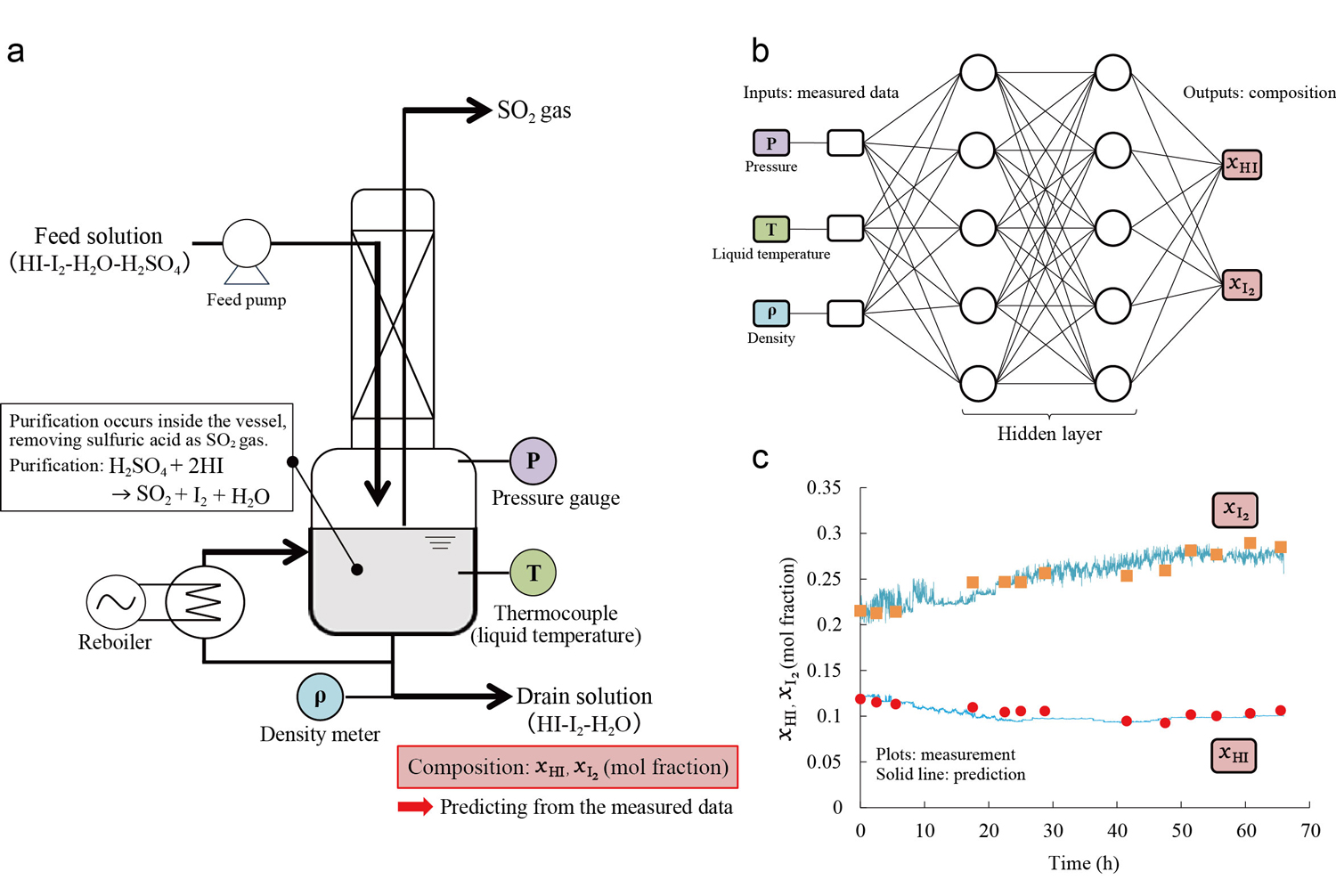
Fig. 1 (a) Experimental setup for the heavy liquid purification column, (b) deep neural network for composition prediction, and (c) comparison of the measured and predicted solution compositions based on the experimental data obtained during operation of the heavy liquid purification column
The Iodine–Sulfur (IS) process, a carbon-free hydrogen production method that utilizes the high-temperature heat generated by high-temperature gas-cooled reactors, is a chemical process that decomposes water through a series of reactions involving iodine (I) and sulfur (S).
To achieve stable hydrogen production, precisely controlling the composition of gas and liquid mixtures containing multiple components, such as hydrogen iodide and sulfuric acid, in each reactor is essential. However, due to the highly corrosive and high-temperature acidic environment of the IS process, available measurement instruments are limited, making it difficult to continuously and directly measure the composition in real time.
To address this challenge, a method to predict composition using a deep neural network (DNN), which takes advantage of correlations between measurable physical properties and the composition, was developed. In the IS process, such correlations are complex, and theoretical equations linking physical properties to composition have rarely been established. In contrast, this method can predict composition by learning from past measurement data, even without explicit theoretical relationships.
Using a heavy liquid purification column, which removes sulfuric acid from hydrogen iodide acid, as a model case, liquid composition from the measured time-series data of density, liquid temperature, and pressure was estimated. The predicted results successfully reproduced the experimentally measured compositions (Fig. 1).
Because this method can be applied to each reactor in the IS process, real-time prediction of composition changes throughout the entire process is possible, contributing to more stable and reliable process control.

If you have any comments or feedback about this page, please click the button to share your thoughts with us.