Publication Date: January 13, 2026
Access counts:0
How Does the Spread of Nuclides Affect the Performance of a Geological Disposal System?
-Effect of the Longitudinal Dispersion Length on Maximum Nuclide Release Rate-
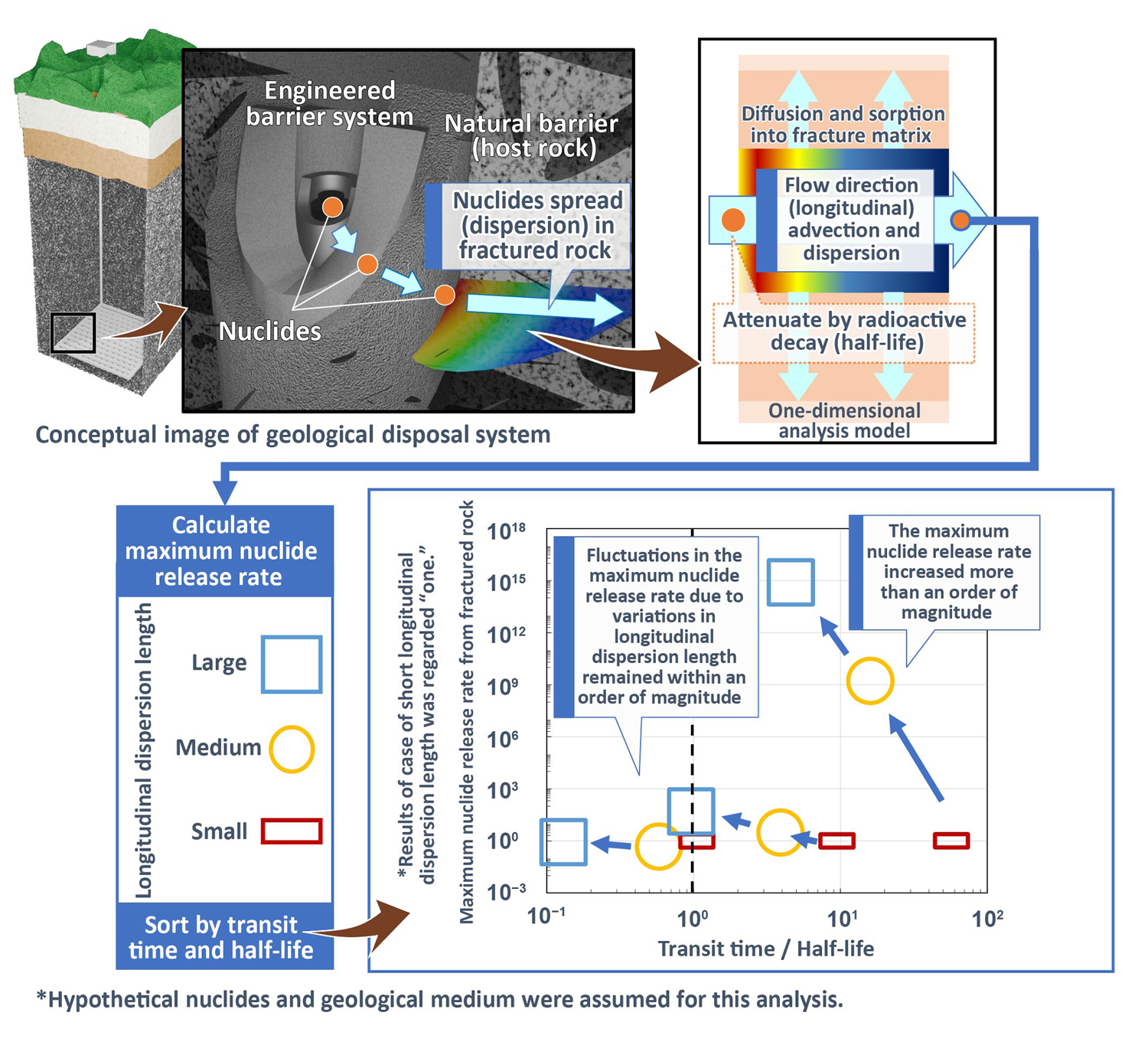
Fig. 1 Effect of the longitudinal dispersion length on the maximum nuclide release rate from fractured rock
In the geological disposal of high-level radioactive waste, nuclides leached from the waste migrate through the host rock after being released from the engineered barrier system toward the ground surface. During this migration, the nuclides spread spatially because of variations in groundwater flow velocity and are attenuated by radioactive decay. This “spread” is known as “hydrological dispersion” (hereafter, dispersion). It is expected that the radiation impact on humans may be reduced as a result of decreased nuclide concentrations caused by dispersion.
In geological disposal, numerical models are essential for radionuclide migration analysis to evaluate long-term safety beyond 100,000 years, and parameters must be set with consideration of “conservatism.” The longitudinal dispersivity, which represents the degree of dispersion, is challenging to measure and therefore remains a highly uncertain parameter. Therefore, this study aims to clarify the impact of dispersivity on the migration behavior of radioactive nuclides by conducting a parameter analysis of dispersivity and nuclide half-life for hypothetical radioactive nuclides and geological media.
First, we analyzed the effects of longitudinal dispersivity on migration behavior of nuclides in fractured rock, taking into account a wide range of conditions for both half-life and retardation coefficient of nuclides. The results were summarized in a correlation plot showing the relationship between the maximum nuclide release rate and the ratio of nuclide transit time to nuclide half-life.
Overall, in the case of relatively short transit times, fluctuations in the maximum nuclide release rate due to variations in longitudinal dispersivity remained within a factor of a few. On the other hand, in the case of longer transit times, the maximum nuclide release rate increased by several orders of magnitude or more. As a result, it was found that the impact patterns differed significantly between the two cases (Fig. 1). These findings provide valuable insights for selecting the conservative values for the inherently uncertain longitudinal dispersivity in safety assessment.

If you have any comments or feedback about this page, please click the button to share your thoughts with us.