Publication Date: March 31, 2026
Access counts:0
Investigation of TRU Burning Fast Reactor Core Concepts
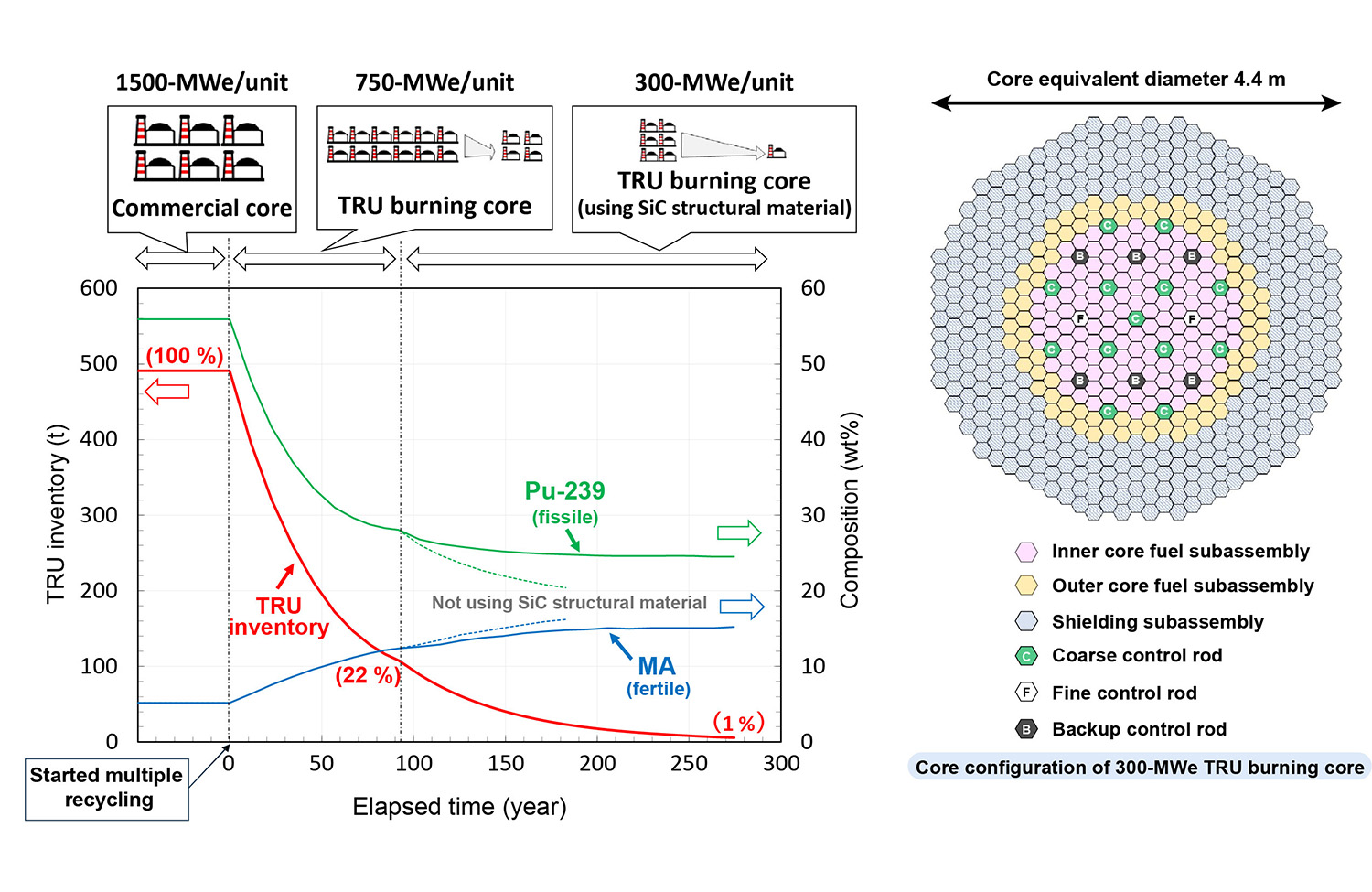
Fig. 1 Reduction of TRU inventory and degradation of TRU composition by multiple recycling with burning core
Fast reactors can breed their own fuel while generating electricity. Furthermore, they can utilize transuranic elements (TRU)*1 such as fertile Plutonium (Pu) and long-lives minor actinides (MA) as fuel, which contributes to environmental burden reduction such as the volume reduction of radioactive waste. This study showed a concept of a TRU burning fast reactor core that allows for multiple recycling until the TRU inventory reduces almost completely in an anticipated phaseout scenario in the distant future.
As shown in Fig. 1, multiple recycling degrades the TRU composition, i.e., it decreases Pu-239 and increases MA. This causes deterioration in core safety parameters*2. The key point of the TRU burning core design was to achieve high TRU consumption performances while keeping the safety parameters within the design limits.
In the design of the TRU burning core, silicon carbide (SiC) structural materials were used for the cladding and wrapper tubes to improve the safety parameters*3. In addition, using SiC structural materials was found to mitigate the TRU degradation (Fig. 1). These characteristics allowed for the construction of the burning core that ensure core safety on the safety parameters mentioned here for all degraded TRU compositions during multiple recycling. A simplified phaseout scenario calculation showed that the burning core has the potential to reduce the TRU inventory to 1 % of its initial amount in about 300 years (Fig. 1). In response to societal needs, the fast reactors can achieve not only fuel breeding but also environmental burden reduction. They represent a useful power generation concept for nuclear fuel material management.
*1 Plutonium has fissile isotopes such as Pu-239 and Pu-241, and fertile isotopes such as Pu-240. Any of the nuclides called minor actinides, such as americium-241 and curium-244, are fertile. These nuclides with atomic numbers greater than uranium are called transuranic elements (TRU).
*2 TRU degradation mainly deteriorates the Doppler coefficient and sodium void reactivity. The Doppler coefficient represents the magnitude of negative reactivity caused by the Doppler effect, where neutron absorption reactions increase due to rise of fuel temperature. The sodium void reactivity represents the reactivity change caused by a loss of coolant. It consists of a positive component due to hardening of the neutron spectrum and a negative component due to increased neutron leakage. Generally, sodium void reactivity has a positive reactivity effect in large reactor cores.
*3 Silicon carbide (SiC) structural materials were one of the high strength ceramics. The relatively weak neutron moderating effect due to silicon and carbon in the SiC structural materials contributed to the improvement of the Doppler coefficient and sodium void reactivity.

If you have any comments or feedback about this page, please click the button to share your thoughts with us.