Publication Date: March 31, 2026
Access counts:0
New Type of Fission Discovered Using Einsteinium
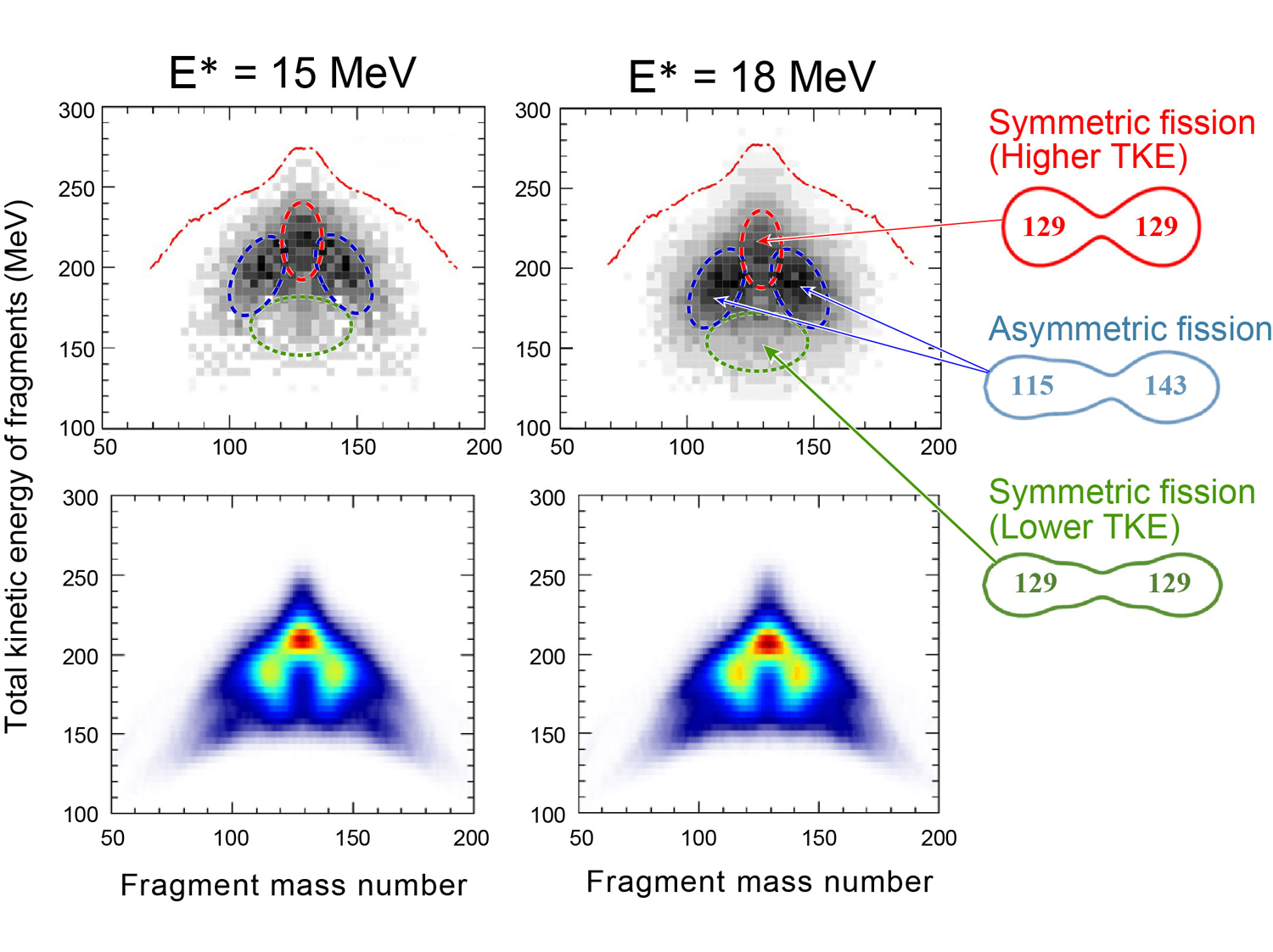
Fig. 1 Fission-yield distributions of the mendelevium (258Md) nucleus as a function of fragment mass and total kinetic energy
The heaviest element that can exist, and hence, to what extent the periodic table of elements extends, is largely determined by the stability of the nuclei against fission. This stability depends on how the nucleus breaks apart through various forms. However, except for uranium, the fission process of heavier elements larger than atomic number 100 remain largely unknown.
This study is the first to observe nuclear fission in the mendelevium nucleus 258Md (atomic number 101). To produce this nucleus, we collided a helium nucleus (4He) accelerated by the JAEA tandem accelerator with an einsteinium target (254Es), which is specially prepared. As a result, three distinct fragmentation patterns could be identified in 258Md, as shown in the Fig. 1 top. Furthermore, we discovered that an asymmetric fission component, which produces larger and smaller fission fragments, increases along with the excitation energy in 258Md. These phenomena are not observed in uranium. In addition, we could reproduce the experimental data using newly developed, precise theoretical calculations (Fig. 1 bottom).
This achievement is one step toward understanding the limits of elemental existence. We believe the developed theoretical fission model can be widely used in atomic energy applications.

If you have any comments or feedback about this page, please click the button to share your thoughts with us.