Publication Date: March 31, 2026
Access counts:0
Discovery of a New Variable to Control Forces Generated by the Casimir Effect
-Successful Formulation of the Finite-Density Casimir Effect Leading to the Development of Ultra-Small Devices-
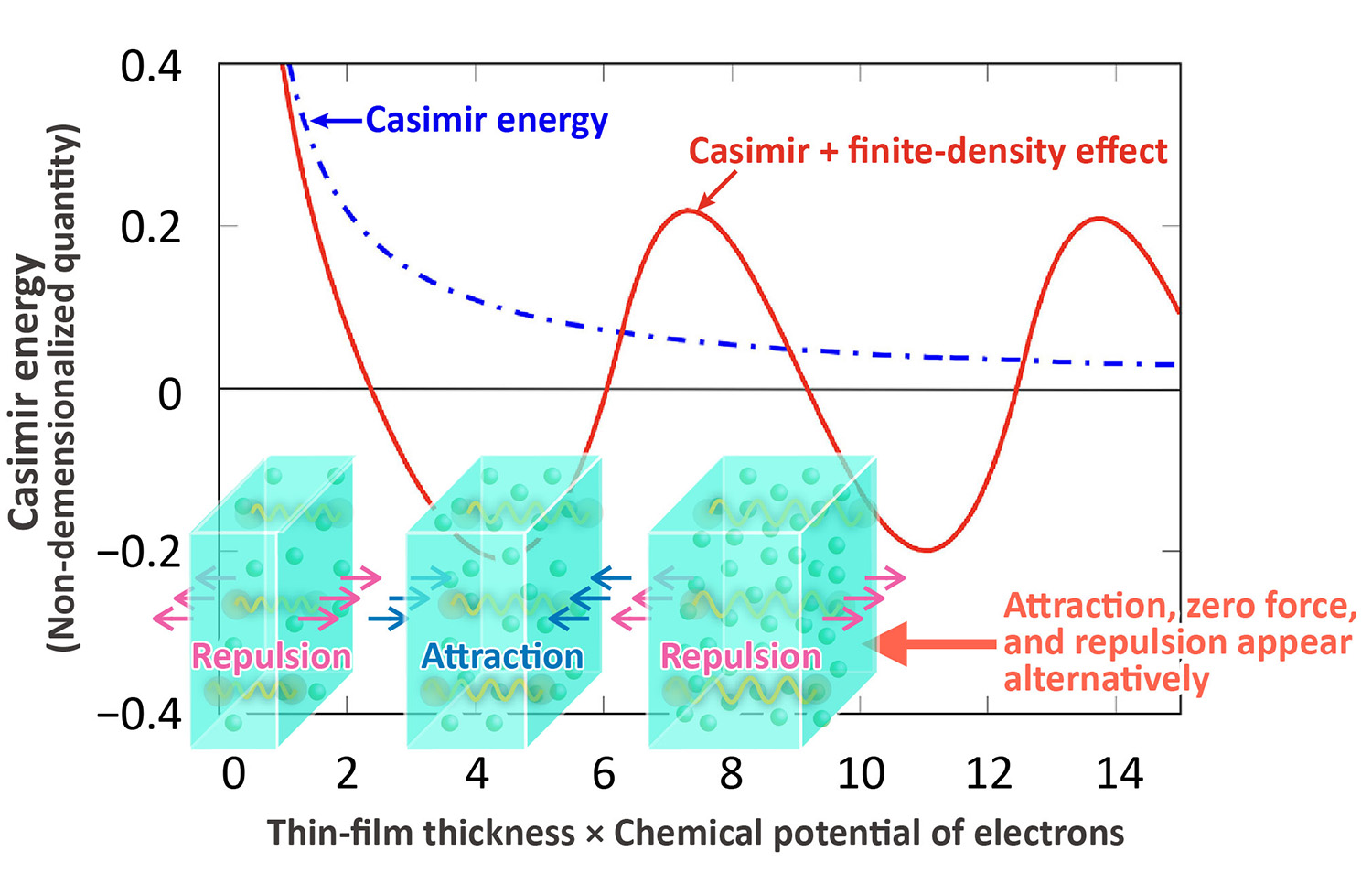
Fig. 1 Casimir effect in thin-film materials
The Casimir effect is a phenomenon in which a tiny attractive force arises between two metal plates when they are placed a few micrometers apart, because the zero-point energy* of photons between the plates changes. It is well known in physics as a pressure arising from apparently empty space. In recent years, Casimir engineering, the engineering application of the Casimir effect, has increasingly gained attention, and it is expected to contribute to the development of ultra-small devices equipped with high-precision pressure sensors, highly controllable micro-springs, and low-friction bearings. A key issue in such applications is how to control the force generated by the Casimir effect. In fact, Casimir effect–induced forces can arise not only between plates but also inside thin films and microstructures. Consequently, device design that controls these forces in a broader range of situations is needed.
We focused on electron density as a variable for controlling the force generated by the Casimir effect. Unlike photons, electrons constitute matter, and therefore density effects become important. Conventionally, the main factors of control have been the material properties and plate geometry. However, once a device has been fabricated, these parameters are difficult to adjust. Meanwhile, because zero-point energy also changes with temperature, temperature has been considered an easily tunable variable. However, temperature alone leaves a limited range of possible behaviors. Therefore, we incorporated the density effects into the theory and showed that the electron-origin Casimir-effect–induced force generated inside thin-film materials varies with the film thickness and electron density (chemical potential). As a result, flexible control, not only of attractive and repulsive forces but also of conditions where the net force becomes zero, has become possible.
* In quantum mechanics, even when no external force is applied, a particle cannot be brought to complete rest. The unavoidable minimum energy associated with this is called "zero-point energy."

If you have any comments or feedback about this page, please click the button to share your thoughts with us.