Publication Date: February 25, 2026
Access counts:0
Integral Experimental Database for Validation of Nuclear Data of Transuranic Nuclides Including Minor Actinides
Table 1 Database of TRU integral experiments
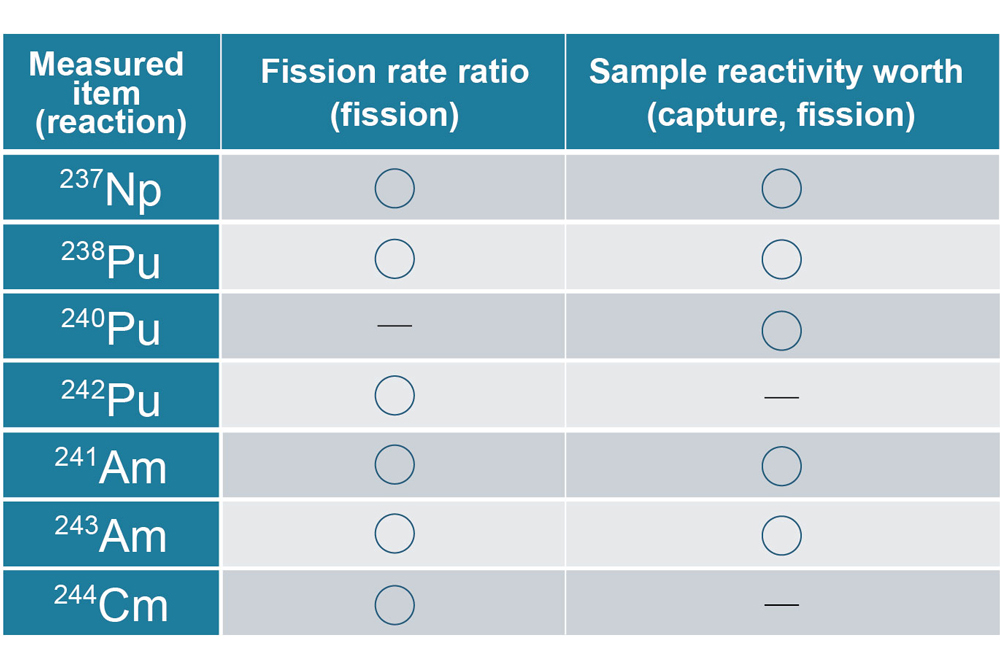
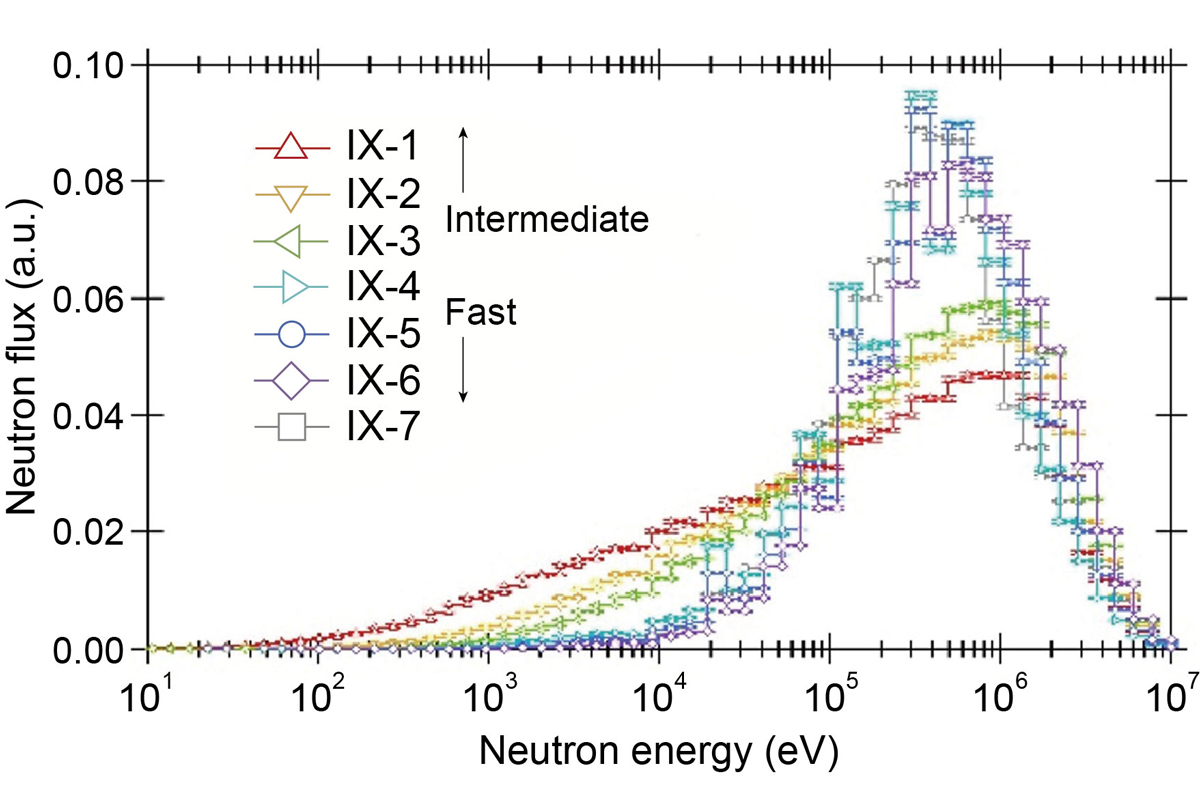
Fig. 1 Systematically varied neutron energy spectra of FCA-IX assemblies
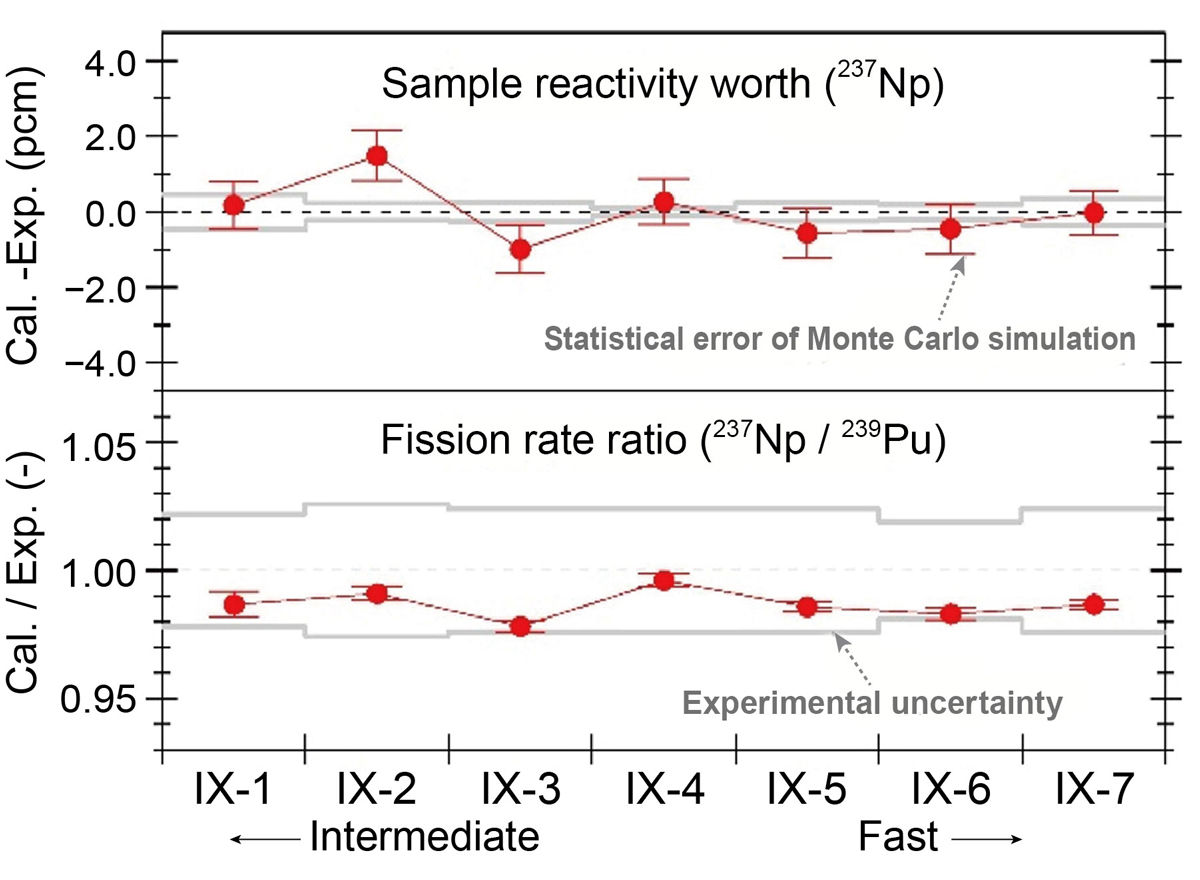
Fig. 2 Example of integral validation
JENDL-5 accurately predicts the sample reactivity worth and fission rate ratio of 237Np.
Integral validation of nuclear data for transuranic (TRU) nuclides is a key technology in addressing major challenges, such as the development of innovative reactors and the reduction of radioactive waste. However, experimental data essential for integral validation, particularly for minor actinides, remain extremely scarce worldwide.
In this study, experimental data*1 on TRU nuclides obtained from the Fast Critical Assembly (FCA) was re-evaluated and a comprehensive integral experimental database (Table 1) to support nuclear data validation was established. This database ensures high reliability, with experimental uncertainties rigorously evaluated to meet international standards in the field of reactor physics. The database has two notable features:
(1) While a single integral experiment typically lacks detailed neutron energy information, this database systematically covers multiple neutron energy spectra—from intermediate to fast regions (Fig. 1)—enabling validation with a focus on energy dependence.
(2) In addition to criticality, the database includes fission rate ratios and sample reactivity worths. This enables integral evaluation of both fission and capture cross sections for TRU nuclides (Fig. 2).
By offering broad coverage of neutron spectra and diverse nuclear characteristics (criticality*2, fission rate ratio*3, sample reactivity worth*4), this database is anticipated to enhance reliability of TRU nuclear data.
*1 Mukaiyama, T. et al., Rad. Eff. 93 (1–4), 147 (1986).
*2 Fukushima, M. et al., J. Nucl. Sci. Technol. 53 (3), 406 (2016).
*3 Fukushima, M. et al., J. Nucl. Sci. Technol. 54 (7), 795 (2017).
*4 Fukushima, M. et al., J. Nucl. Sci. Technol. 61 (4), 478 (2024).

If you have any comments or feedback about this page, please click the button to share your thoughts with us.