Publication Date: February 13, 2026
Access counts:0
Successful Separation and Recovery of Americium for Semi-Permanent Power Sources Using a Practical New Technique
-Significant Progress toward Practical Utilization of Valuable Elements in Spent Nuclear Fuel-
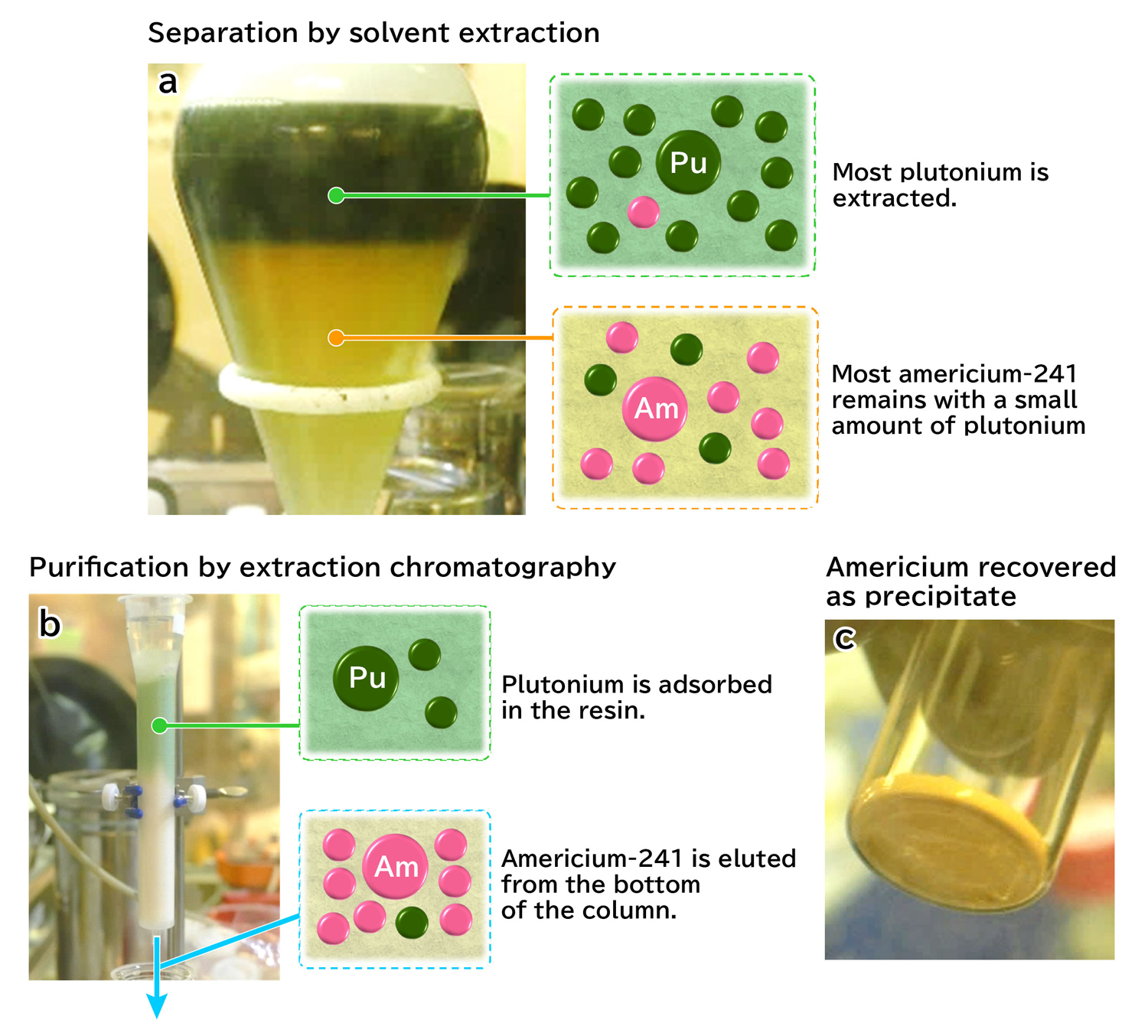
Fig. 1 Separation by solvent extraction (a), purification by extraction chromatography (b), and americium recovered as precipitation (c)
Batteries are indispensable in our daily lives. In an effort to develop stable and long-lasting power sources, various materials are being considered. One such possible battery is a semi-permanent power source that converts the decay heat of radioactive materials into electricity using thermoelectric elements. A semi-permanent power source could be applied to space probes operating beyond Jupiter, where solar power generation becomes insufficient.
With a long half-life of 432.2 years, americium-241 is a suitable radioactive isotope for use in semi-permanent power sources. We have previously developed a solvent extraction technique, known as the “SELECT process,” which can separate americium, uranium, rare earth elements, etc. from the dissolution solutions of spent nuclear fuel and high-level radioactive liquid waste.* Building on the knowledge obtained in the SELECT process, a technique to recover americium-241, which is generated by the beta decay of long-stored plutonium-241, using chemical methods such as solvent extraction (Fig. 1a) and extraction chromatography (Fig. 1b) was developed.
This technique employs an incinerable extractant, which reduces the amount of waste generated during the recovery process. Furthermore, the amount of americium recovered at room temperature was successfully increased (Fig. 1c). This novel technique is also versatile and can be applied to the separation and recovery of other valuable elements such as strontium.
* Ban, Y. et al., Recovery of Minor Actinides from High-Level Liquid Waste by N,N,N',N',N'',N''-Hexaoctyl Nitrilotriacetamide (HONTA) Using Mixer-Settler Extractors, Progress in Nuclear Science and Technology, vol.8, 2025, p.243–247.

If you have any comments or feedback about this page, please click the button to share your thoughts with us.