Publication Date: March 10, 2026
Access counts:0
Utilizing Hydrogen as a Beneficial Element in Steel Development
-Investigation of How Hydrogen Enhances the Strength and Ductility of Stainless Steel Using Neutron Diffraction-
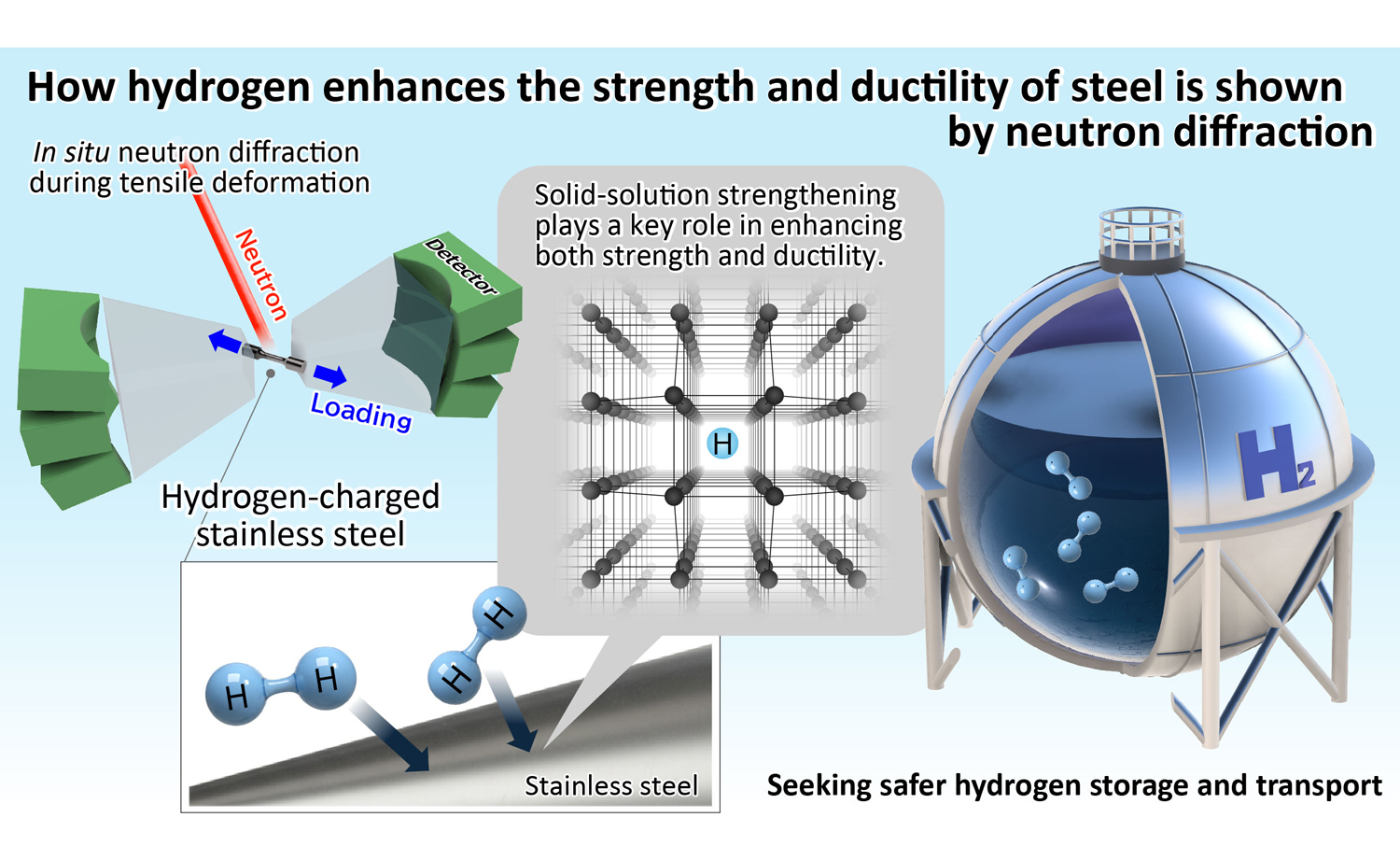
Fig. 1 Overview of this work
Hydrogen has attracted attention as a promising energy carrier in the realization of a sustainable society. On the other hand, it has also been regarded as a “villain” leading to embrittlement in steels used in infrastructures. With this background, recent studies have reported that introducing hydrogen into Type 310S stainless steel (Fe–24Cr–19Ni, mass%) enhances both strength and ductility.
To clarify this intriguing phenomenon, in situ neutron diffraction experiments during tensile testing were conducted using the Engineering Materials Diffractometer “TAKUMI” (BL19), at J-PARC (Fig. 1). The high penetration ability of neutrons enables non-destructive diffraction analysis of bulk samples under tensile deformation. Diffraction analysis showed that the lattice expanded after hydrogen addition, indicating that hydrogen dissolved into the lattice. This expansion suppressed dislocation motion, increasing the steel’s strength through solid-solution strengthening. In addition, the higher stresses generated during deformation promoted the early formation of deformation twins, which accommodate strain through mirror-symmetric shear across the twin plane, contributing to improved ductility.
From these findings, hydrogen-induced solid-solution strengthening was found to play a key role in simultaneously enhancing both strength and ductility of Type 310S stainless steel. This discovery provides new insights in the development of advanced steels that can ensure safe and reliable hydrogen storage and transportation technologies.

If you have any comments or feedback about this page, please click the button to share your thoughts with us.