Publication Date: March 31, 2026
Access counts:0
Examining the Relationship Between Caesium-137 Detected in the CTBT Okinawa Radionuclide Monitoring Station and Asian Dust
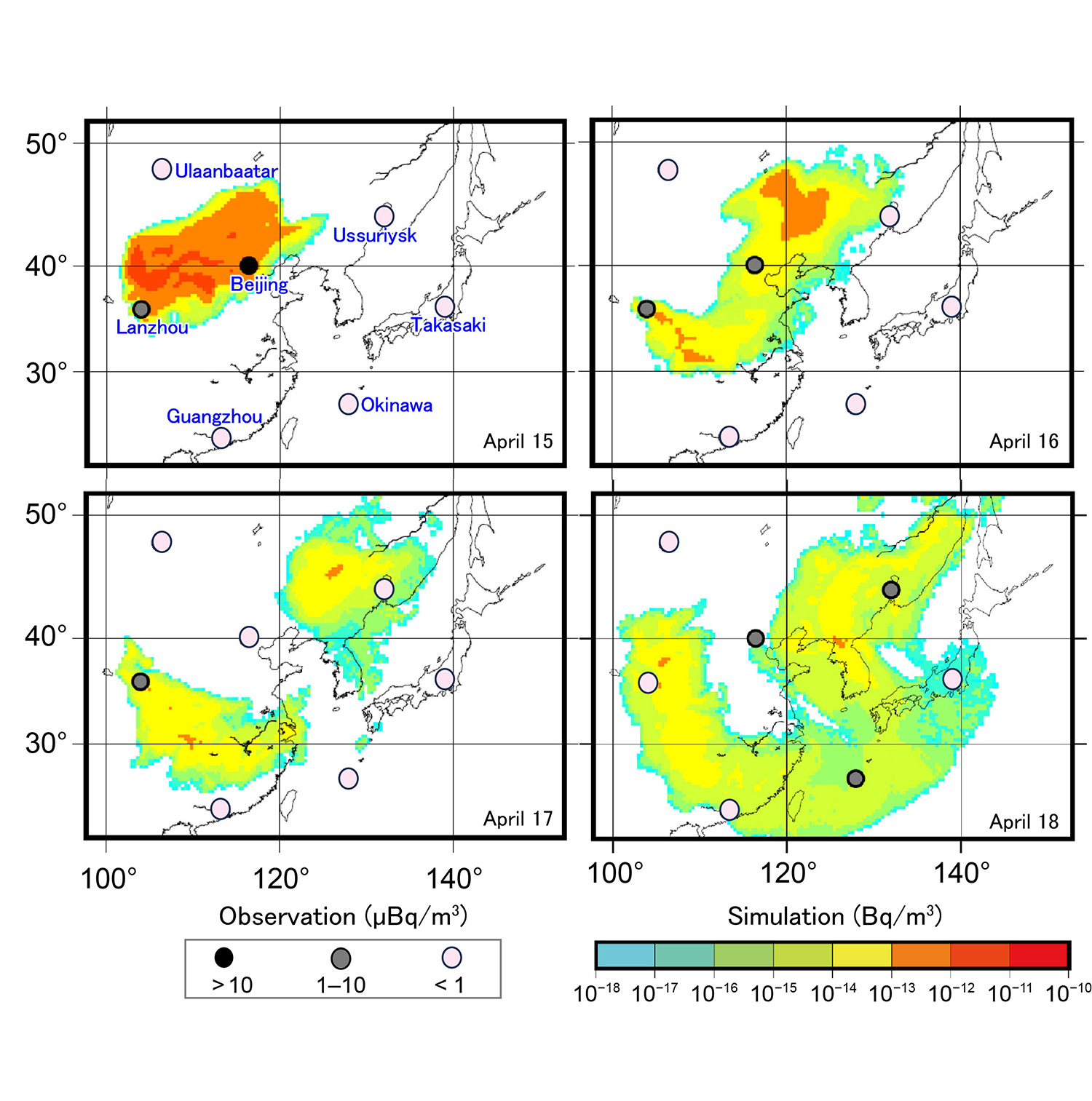
Fig. 1 Results of an atmospheric dispersion simulation assuming a uniform release of caesium-137 from the Loess Plateau in China
 in the figure).
In cooperation with the Comprehensive Nuclear-Test-Ban Treaty Organization (CTBTO), our team conducts radionuclide monitoring and data analysis to detect nuclear testing.
Japan hosts two CTBT radionuclide monitoring stations, located in Okinawa and Takasaki. Despite the absence of nuclear facilities in the vicinity, Cs-137 is occasionally detected at the Okinawa Station in Onna Village, Okinawa Prefecture. Identifying the sources of such sporadic detection events is crucial for reliably detecting nuclear tests. Given that Cs-137 is most frequently detected in Okinawa during spring and previous research has confirmed that Asian dust can transport Cs-137, this study hypothesized that detetions in Okinawa are associated with Asian dust. This hypothesis was tested through radionuclide data analysis and atmospheric dispersion simulations.
Springtime detections of Cs-137 at the Okinawa Observatory from 2020 to 2023 showed a high correlation with detections in Beijing and Lanzhou in China and Ulaanbaatar in Mongolia. Additionally, observations of Asian dust in Japan showed a high correlation with Cs-137 detections in Takasaki, Beijing, Lanzhou and Ulaanbaatar. Furthermore, atmospheric dispersion simulations were employed to model the arrival of Cs-137 at CTBTO observatories from the deserts of inland China, the primary source of Asian dust (Fig. 1).
These results qualitatively support the hypothesis that the Cs-137 detected at observatories in East Asia originates from global fallout propagated via Asian dust. Moving forward, we aim to conduct further case analysis to enhance our understanding of background levels at observatories located near regiouns such as the Sahara Desert, where past nuclear tests were conducted.

If you have any comments or feedback about this page, please click the button to share your thoughts with us.