Publication Date: March 18, 2026
Access counts:0
Elucidating the "Unobservable Damage" of the 1F Unit-2 Reactor Pressure Vessel
-Analysis of Molten Material Behavior with the Moving Particle Semi-Implicit (MPS) Method Under Conditions of Eutectic Melting-
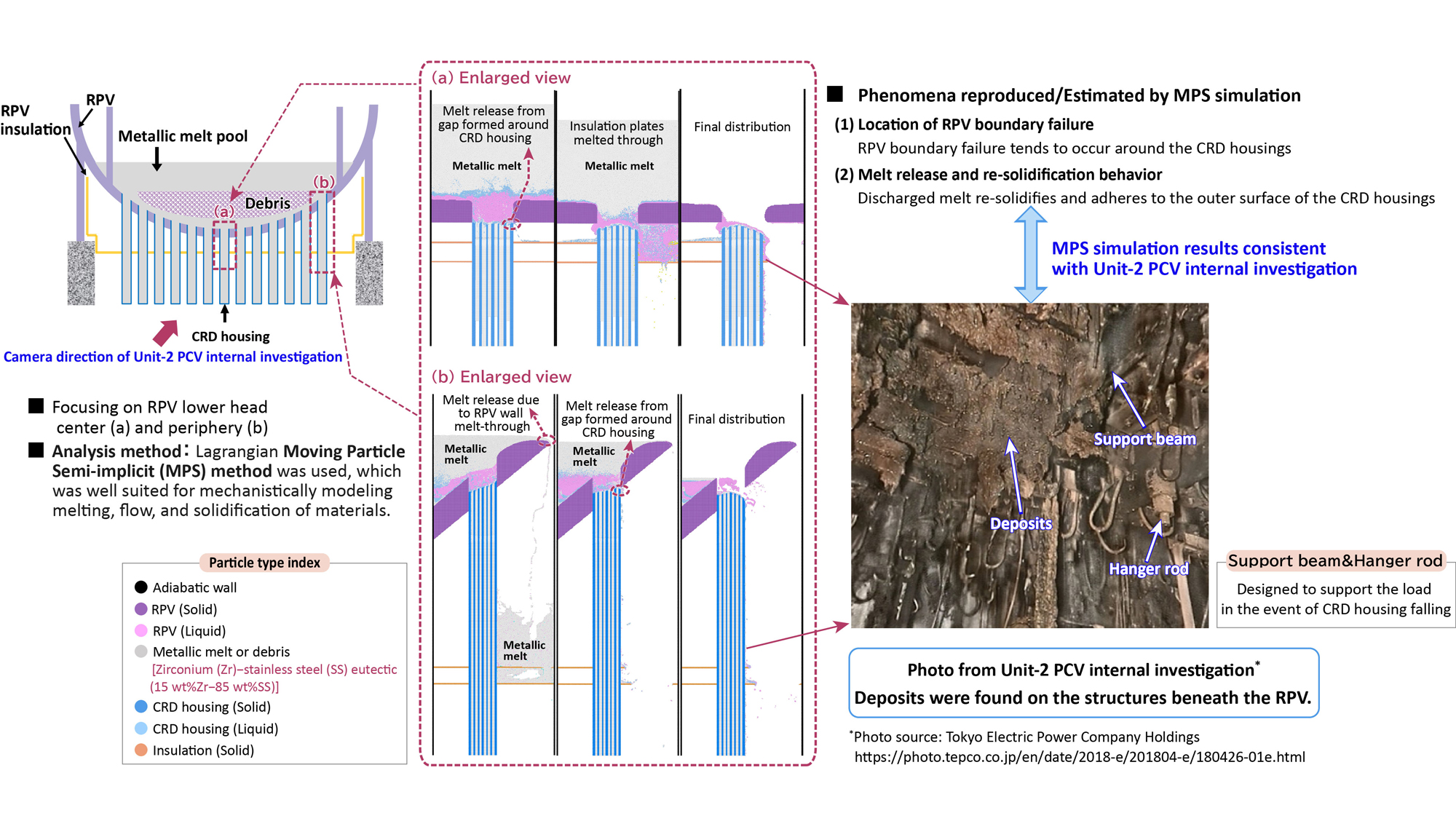
Fig. 1 Analysis results of local failure and core material relocation behavior in the Reactor Pressure Vessel (RPV)
lower structure of Fukushima Daiichi Nuclear Power Station Unit-2
*Photo source: Tokyo Electric Power Company Holdings https://photo.tepco.co.jp/en/date/2018-e/201804-e/180426-01e.html
At TEPCO's Fukushima Daiichi Nuclear Power Station (1F) Unit 2, no clear evidence of large-scale damage to the Reactor Pressure Vessel (RPV) has been confirmed. However, traces and deposits beneath the vessel indicate that molten core material may have relocated into the lower regions.
To elucidate this unprecedented phenomenon, JAEA conducted experiments simulating the penetration structures in the RPV lower head and demonstrated that localized melting can occur around these structures due to eutectic reactions between zirconium (Zr) and stainless steel (SS) (Fig. 1). However, experimentally reproducing the subsequent outflow, relocation, and solidification of molten material is extremely difficult.
Therefore, this study employed the Moving Particle Semi-implicit (MPS) method, which represents fluids and solids as a collection of many particles and is capable of physically based simulation of complex deformation behaviors like melting, flow, and solidification by tracking the movement of the particles and their interactions. In this analysis, in addition to the thermal and structural conditions of Unit-2 at the time of the accident, the eutectic reaction was modeled by assigning a lower melting temperature to particles placed at the Zr-SS interface, based on the experimental data that reflected Zr-SS eutectic reaction temperature obtained by JAEA. The analysis reproduced localized boundary failure around Control Rod Drive (CRD) housings embedded in the RPV wall and the re-solidification of discharged molten core material on the outer surfaces of the housings. These results are consistent with the state of deposits confirmed by the Primary Containment Vessel (PCV) internal investigation of Unit-2.
This research demonstrates that the Zr-SS eutectic reaction contributed to the localized structural weakening and melt release within the Unit-2 RPV lower structure. The findings provide valuable insight into in-vessel accident progression and support improved estimation of fuel-debris distribution.

If you have any comments or feedback about this page, please click the button to share your thoughts with us.