Publication Date: April 8, 2026
Access counts:0
R&D on Laser-Induced Breakdown Spectroscopy (LIBS) for Remote Elemental Analysis
-Ultralong Fiber-Optic, Acoustic-Wave-Assisted Microchip LIBS for Remote Elemental Analysis-
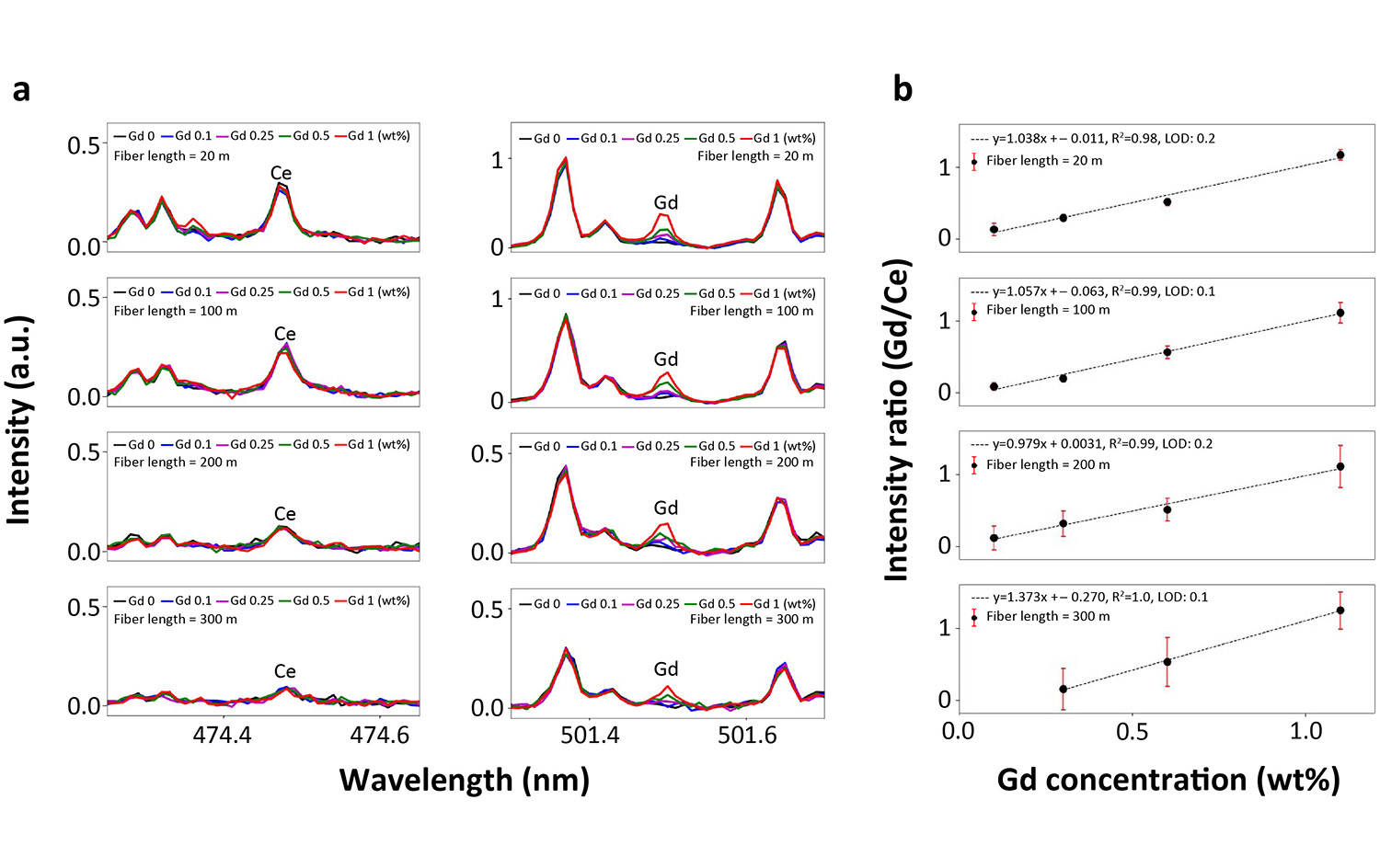
Fig. 1 Qualitative and quantitative analysis of Gd using various lengths of optical fiber
Remote, onsite, and multi-elemental analysis is essential at every stage of the safe decommissioning of the TEPCO’s Fukushima Daiichi Nuclear Power Station (FDNPS), from initial site characterization to material storage. However, due to limited access to the reactor vessels and extremely high radiation dose rates, the applicability of conventional analytical methods is technically constrained. Because the distance between safe working areas and nuclear fuel debris is expected to exceed 100 m, a remote analytical method for fuel debris inspection is crucial. To address this, fiber-optic, acoustic-wave-assisted microchip laser-induced breakdown spectroscopy (AW-mLIBS) has been developed.
AW-mLIBS is a form of atomic emission spectroscopy where a high-energy pulsed laser is focused onto a sample surface to ablate material and generate high-temperature plasma. The light emitted from this plasma contains characteristic spectra corresponding to the elements present, which are analyzed in real time via a spectrometer. This approach uses a compact microchip laser position near the sample. The pumping diode laser is delivered from a remote location through a radiation-resistant fiber optic cable (FOC), while second cable collects the light emitted by the resulting plasma. At the same time, a microphone captures the sound of the laser hitting the sample. We use this sound to find the optimal focusing position for the laser; by adjusting the focus until sound is at its loudest, we ensure the system is working and providing consistent data.
This research investigated the qualitative (which elements are present at the measurement position) and quantitative (how much of each element is present at the measurement position) performance of the AW-mLIBS system using various FOC lengths to detect Gadolinium (Gd) at concentrations of 0.1–1.1 wt% in simulated debris. Gd detection is critical as Gd2O3 was used in some fuel rods at FDNPS. As shown in Fig. 1a, Gd emission lines were detected at all fiber lengths for concentrations above 0.1 wt%. However, at a fiber length of 300 m, Gd was not detectable below 0.1 wt% due to signal attenuation, as the spectra at this level are indistinguishable from those of the blank sample. Conversely, the emission intensity of the Cerium (Ce), used as a surrogate for uranium, remained stable, as its concentration was constant across all fiber length. By utilizing the Gd (501 nm)/Ce (474 nm) intensity ratio via a univariate calibration method, the limit of detection (LOD) for Gd was determined to be 0.1–0.2 wt% (Fig. 1b).

If you have any comments or feedback about this page, please click the button to share your thoughts with us.