Publication Date: October 28, 2026
Access counts:0
Unraveling High-Temperature Specific Heat Anomalies in Nuclear Materials at the Atomic Scale
-Machine-Learning Simulations Reveal What Happens Before Melting-
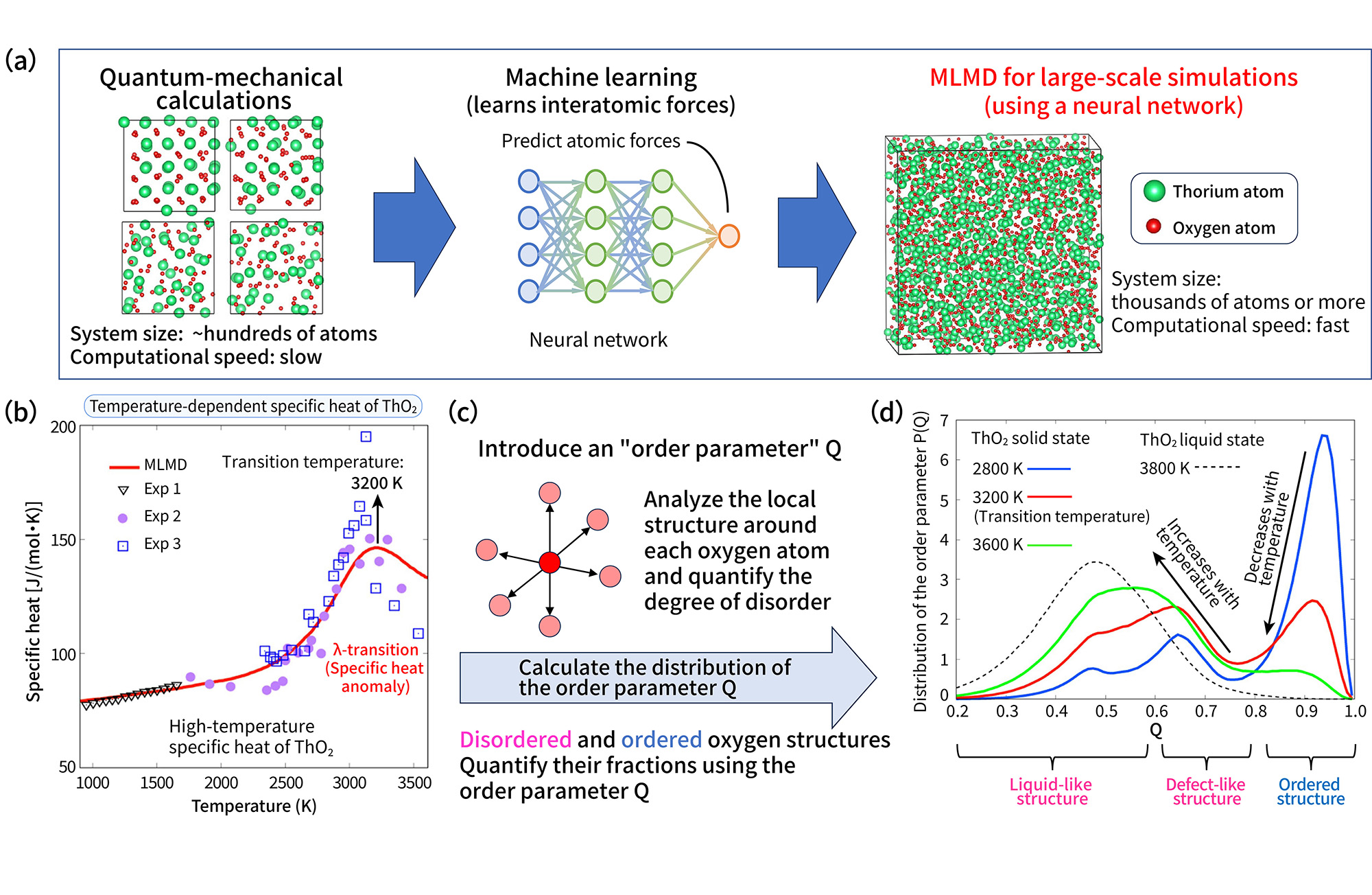
Fig. 1 High-temperature simulations of fluorite-structured material using machine-learning molecular dynamics
Thorium dioxide (ThO₂), a nuclear fuel material, and lithium oxide (Li₂O), a candidate tritium breeding material for fusion reactors, have crystal structures known as fluorite-type structures. At high temperatures, these materials exhibit a phenomenon called a λ (lambda) transition, in which their heat capacity increases sharply (Fig. 1b). However, the atomic-scale mechanism underlying this transition has not been fully understood.
We investigated the high-temperature properties of these materials using machine-learning molecular dynamics (MLMD), which enables fast and accurate atomistic simulations by training machine-learning models on quantum-mechanical calculations. MLMD accurately reproduced experimental properties such as lattice constants, thermal expansion coefficients, and melting points. For Li₂O, the simulations also predicted a previously unobserved λ-transition temperature of 1560 K.
In these materials, some atoms (O atoms in ThO₂ and Li atoms in Li₂O) become increasingly mobile within the crystal as the temperature increases. We therefore introduced a new “order parameter” to quantify the degree of disorder in the local octahedral arrangement of these atoms, in which six atoms surround a central atom in an octahedral geometry (Fig. 1c). Our analysis revealed that three types of local structures—symmetry-preserving ordered structures, defect-like structures, and liquid-like structures—coexist near the transition temperature (Fig. 1d). Above the transition temperature, liquid-like structures become dominant, and the symmetry-preserving ordered structures are progressively lost.
This new picture, in which the λ transition arises from local symmetry breaking, reveals atomic-scale structural changes that occur in high-temperature nuclear materials before melting and is expected to contribute to their design and safety assessment.
Keywords
This work was supported by JSPS KAKENHI Grant Numbers JP24K08574, JP25K01658, and JP23K04637.

If you have any comments or feedback about this page, please click the button to share your thoughts with us.