Publication Date: October 9, 2026
Access counts:0
Conceptual Design of a Pilot-Scale Accelerator-Driven System
-Toward a Safe Nuclear System Dedicated to Minor Actinide Transmutation-
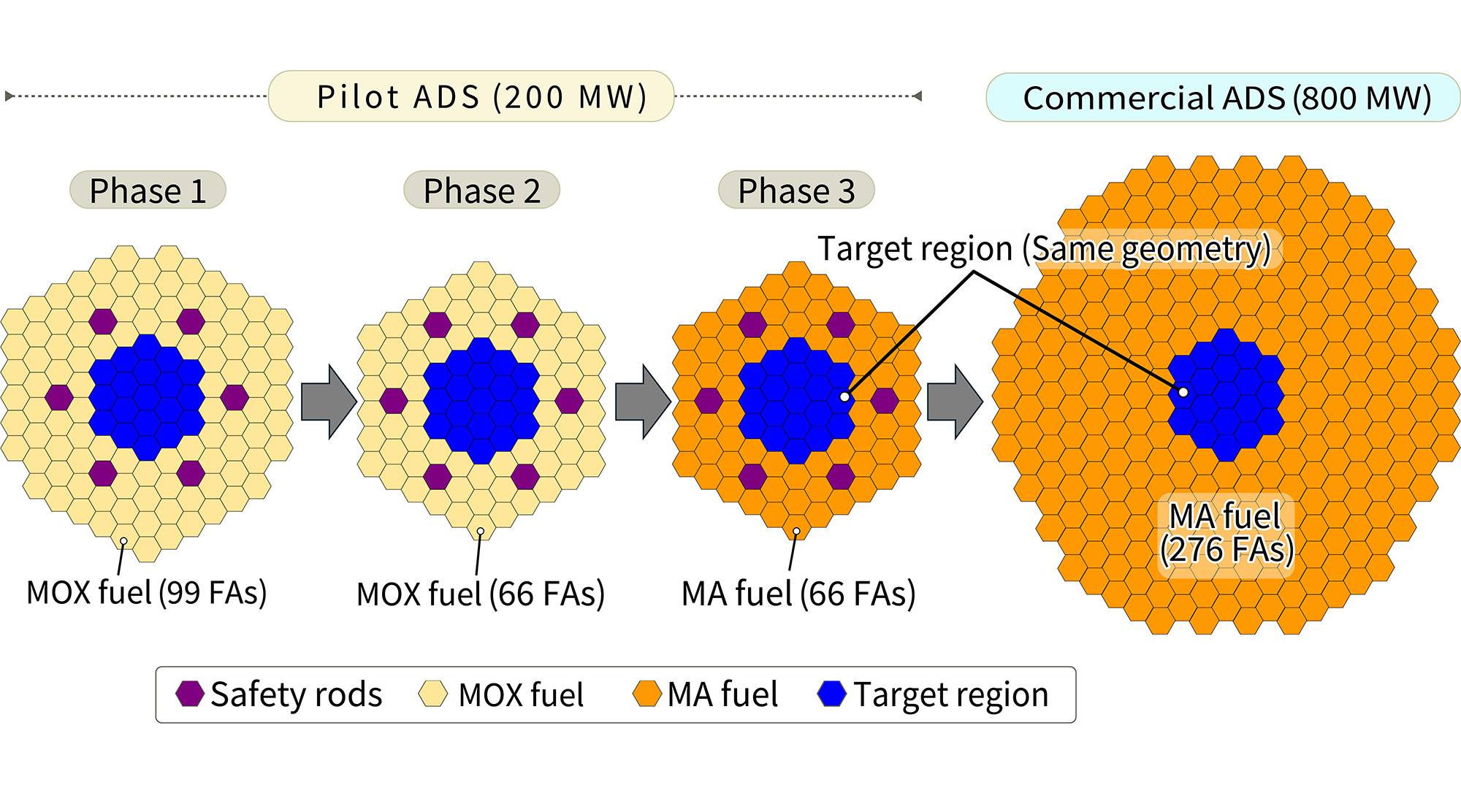
Fig. 1 Subcritical core configurations of the pilot-scale accelerator-driven system (ADS)*1 and the commercial ADS
Transmuting minor actinides (MAs) contained in high-level radioactive waste is an effective way to reduce the waste’s long-term heat generation and radioactivity, thereby contributing to reductions in waste volume and radiotoxicity. The Japan Atomic Energy Agency has designed a commercial accelerator-driven system (ADS)*1 with a thermal output of 800 MW, capable of transmuting approximately 250 kg of MAs per year. Realizing a commercial ADS requires the stepwise demonstration of fuel, accelerator, and beam-window materials technologies.
In this study, we proposed a pilot-scale ADS with a thermal output of 200 MW—one-quarter of that of the commercial ADS—and developed conceptual designs for its core, accelerator, lead-bismuth target, and reactor components for the demonstration of these technologies. The pilot-scale ADS initially uses MOX*2 fuel without MAs, drawing on experience with MOX fuel in existing nuclear systems. From Phase 1 to Phase 2, the core power density is increased to verify basic core performance. The core is then transitioned to MA-bearing nitride fuel in Phase 3 (Fig. 1). The pilot-scale ADS also incorporates safety rods, which are not included in the commercial ADS design, thereby enabling operation with a large subcritical margin. The accelerator is designed as a superconducting linac delivering a 1.0 GeV, 10 mA proton beam, with a more compact configuration and lower beam power than the accelerator for the commercial ADS. Realizing this accelerator requires further development of high-current operation and fault tolerance, which allows operation to continue despite equipment failures. These technologies are to be demonstrated in stages, starting with the low-energy section. We applied most of the international safety design criteria for lead-cooled fast reactors to this conceptual design and developed specifications for the core, accelerator, lead-bismuth target, and reactor vessel.
This study establishes a pathway toward realizing commercial ADSs through the stepwise demonstration of technologies across Phases 1–3, contributing to a sustainable society through the practical application of partitioning and transmutation technologies.
*1 ADS: A system that generates a large number of neutrons by directing an accelerator-produced proton beam onto a target material and then multiplies the generated neutrons in a subcritical core.
*2 MOX: Mixed oxide fuel made from uranium and plutonium, with a proven track record in light-water reactors and other nuclear systems.
Keywords

Research Center for LWR Engineering
If you have any comments or feedback about this page, please click the button to share your thoughts with us.