A nuclear power plant is designed and constructed to minimize hazards to the public even in the event of the worst hypothetical accident. It is necessary to understand the behavior of reactors and fuels under accident conditions more severe than those in hypothetical cases to make a reliable safety evaluation for these accidents. Component failure criteria are especially important for this evaluation and must be examined experimentally.
Development of reactor fuel that can be used for a longer period, termed extended burn-up fuel, is recently progressing world-wide. The purpose is to use uranium resources more efficiently and to reduce the amount of spent fuel produced. In high burn-up fuel, gaseous and other fission products accumulate in the fuel pellets. In addition, degradation of the mechanical properties of the metal cladding that contains the fuel pellets occurs owing to corrosion by the high temperature cooling water and intense radiation damage. Therefore, the integrity of fuel rods under accident conditions must be examined.
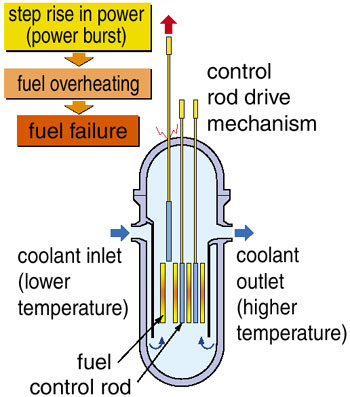
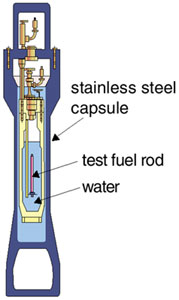
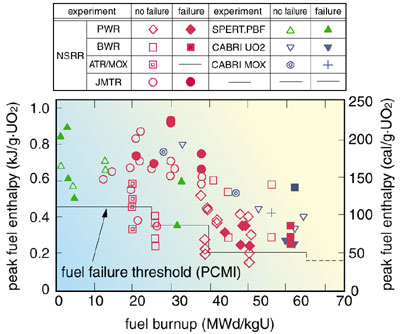
A power burst accident could result from the ejection of a control rod. Driven by the high pressure in the reactor vessel, such an accident could occur due to a failure of a control rod drive mechanism (Fig. 1-1). This type of accident is termed a reactivity-initiated accident (RIA). Fuel behavior under RIA conditions has been studied using the Nuclear Safety Research Reactor (NSRR). A shortened test fuel rod, which is contained in an irradiation capsule (Fig. 1-2), is pulse irradiated under simulated RIA conditions in the NSRR. The test fuel rods are re-fabricated from commercial fuel elements that have been irradiated for extended periods in lead use programs at commercial rectors. The test fuel rods are subjected to a wide range of power burst conditions in the NSRR, covering events much more severe than those hypothesized for actual power plants. These tests revealed that high-burnup fuel rods could fail by a characteristic mechanism at much lower energy depositions than those having lower burnup, as shown in Fig. 1-3. This mode of failure, termed pellet-cladding mechanical interaction (PCMI) failure, has received worldwide attention because of its importance in a safety evaluation. High burn-up fuel, however, has a limited quantity of fissile material because most of this material has been consumed. Therefore, the energy deposition in the fuel during the RIAs is small and, in the currently approved burn-up range, the impact is limited.
NSRR test results are utilized as the fundamental database for safety evaluation and development of reliable light water reactor fuels to extend the burn-up range of fuels. |