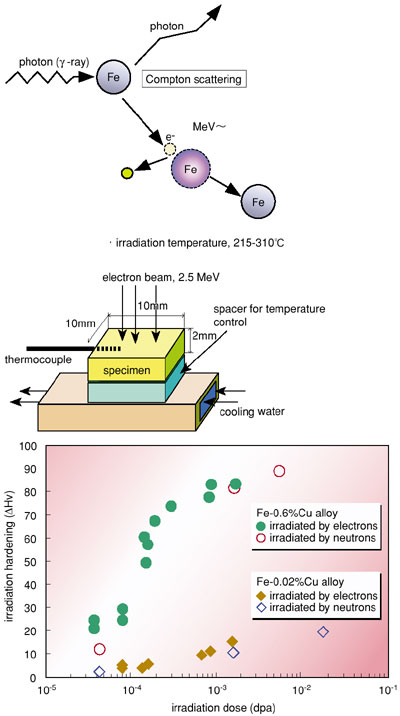
Reactor pressure vessel (RPV) steels are exposed to neutrons from the core during reactor operation. This exposure results in many irradiation defects and nanometer clusters, which increase the hardness of steels in RPVs. Since the hardening of these steels affects the structural integrity of the RPVs, accurate estimates of irradiation hardening are important.
The standard parameter for the current estimation method of irradiation hardening is fast neutron fluence (>1 MeV) or displacement per atom (dpa) caused by fast neutrons. Here, the effects of gamma-rays are ignored. It is true that the contribution of gamma-rays to dpa is very small as compared to fast neutrons, e. g., several percent in commercial RPVs. However, gamma-rays may generate irradiation defects more readily than fast neutrons due to the damage production process. In the case of gamma-rays, simple atomic displacement is caused by energetic electrons, for example, by the Compton scattering process. To study experimentally the irradiation effects of gamma-rays on RPVs, therefore, high-energy electron irradiation can be used as a simulation of gamma-ray irradiation.
In the present experiment, electron and neutron irradiation was performed on Fe-Cu model alloys, and irradiation hardening was compared by means of Vickers hardness (Hv) testing.
Figure 1-6 shows the increase of hardness (DeltaHv) caused by electron and neutron irradiation as a function of dpa. The dose dependence of the hardening is similar for electron and neutron irradiation on a per dpa basis. Thus, it became clear that irradiation hardening generally can be evaluated in terms of dpa, and that the gamma-ray contribution to irradiation hardening of the pressure vessel is only several percent. |