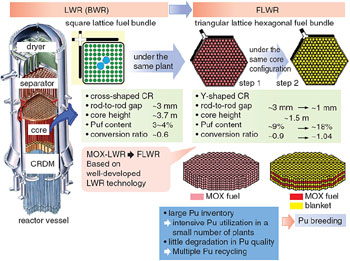
In light water reactors (LWRs), multiple recycling of plutonium (Pu) is technically very limited, but this limitation can be overcome by using the Innovative Water Reactor for Flexible Fuel Cycle (FLWR). The FLWR is a water-cooled reactor based on well- developed LWR technologies. It can realize multiple recycling and breeding of Pu, and can offer corresponding flexibility in future nuclear fuel cycle circumstances such as reprocessing options. Thus, the FLWR enables very effective utilization of the uranium (U) resource and is expected to contribute to future sustainable energy supplies. JAERI, in cooperation with Japanese utilities and LWR plant vendors, has been performing the design study of the FLWR and the development of related technologies, and has confidence in the technical feasibility prospects of this reactor.
As shown in Fig. 1-3, there are two steps to realize the FLWR. In the first step, the standard square fuel assemblies used in LWRs (the same as used in Pu fueled mixed oxide (MOX)-LWRs) are replaced with hexagonal ones. This will arrange MOX fuel rods in a triangular lattice. The spacing between the fuel rods in the assembly is ca. 3 mm, about that now used in LWRs. To minimize the technical transformation from a conventional LWR system, the reactor would use the same reactor plant as an LWR except for the reactor core. The early introduction of the first step FLWR is therefore possible by using MOX fuel from Japanese reprocessing facilities and MOX fabrication facilities, both scheduled to begin operation in the near future. The conversion ratio of this reactor configuration is ca. 0.9, and recycling of Pu a few times is possible.
When reprocessed spent MOX fuels become available, the FLWR will proceed to the second step core, which provides self-sustained multiple recycling and breeding of Pu. Improvement of the core performance is achieved by replacing fuel assemblies. As shown in Fig. 1-3, the outer shape and size of the fuel assembly in this step is compatible with the first step. Within the assembly, the thicker MOX fuel rods having ca. twice the Pu content than those in the first step are arranged with a fuel rod spacing of ca. 1 mm. With this tight pitched fuel lattice design, the breeding of Pu with a conversion ratio (breeding ratio) of ca. 1.04 is achievable.
|