| As the realization of the biological function of a protein is
directly related to its three dimensional structure, it is necessary
to analyze the structure to understand the function. A lot of
important results have therefore been obtained by analyzing the
three dimensional structure by means of x-ray diffraction. However,
as about a half of the constituent elements of a biological substance
are hydrogen which has the least response to x-ray analysis, it
is difficult to determine the location of the hydrogen atoms by
x-ray diffraction. Nevertheless, one can easily determine the
location of hydrogen atoms by neutron diffraction and, moreover,
the energy used for neutron diffraction is lower than that for
x-ray diffraction, which reduces considerably the possibility
of radiation damage. Technically, however, the actual experiment
is rather difficult because the volume of the unit lattice of
a protein crystal is much larger than that of inorganic material
and the intensity of the reflected neutrals is reduced by a factor
of 105 to 106. In order to overcome this difficulty it is necessary
to use a high intensity neutron source and a very large single
crystal. In addition, it becomes necessary to develop a high efficiency
neutron detector (neutron imaging plate) with a wide dynamic range
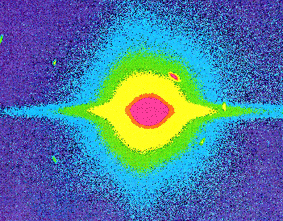
and high spatial resolution. By using the diffraction system and
the detector thus developed, we succeeded in obtaining an image
of the lysozime protein for the first time in the world. From
this result we can obtain hitherto unknown information on the
distribution of hydrogen atoms in biological material. |