 |
||
|
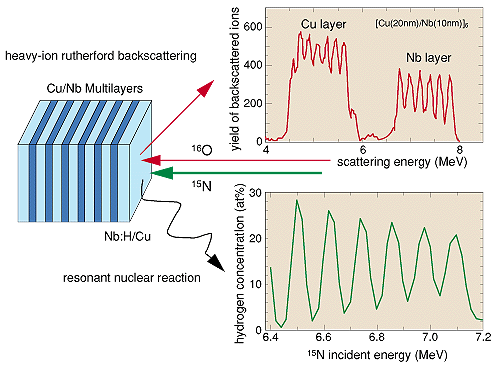
| Multi-layered Nb/Cu prepared by the molecular beam evaporation
technique preserves flat plane boundaries between layers because
Nb and Cu do not melt into each other. This meets our expectation
for example, for fabricating effective x-ray reflecting materials.
For the existing interface-lattice strain to be relaxed, hydrogen
atoms are expected to play an important role and it is needed
to know the chemical state of hydrogen introduced to clarify its
role. By examining the evaporation conditions (substrate temperature and its orientation, etc), we succeeded in preparing a multilayer sample with flat plane boundaries and without mutual diffusion between the layers. Furthermore we have analyzed the depth distribution of hydrogen atoms in the multilayer using the ion-beam resonant nuclear reaction method to find out that the hydrogen exists locally in the Nb layers. |
| Reference
S. Yamamoto et al., Analysis of Hydrogen in Nb/Cu Multilayers using Ion Beams, J. Alloys Comp., 231, 310 (1995). |
| Select a topic in left column |  |
|
Persistent Quest-Research Activities 1996 Copyright(c)Japan Atomic Energy Research Institute |