|
||
|
|
||
|
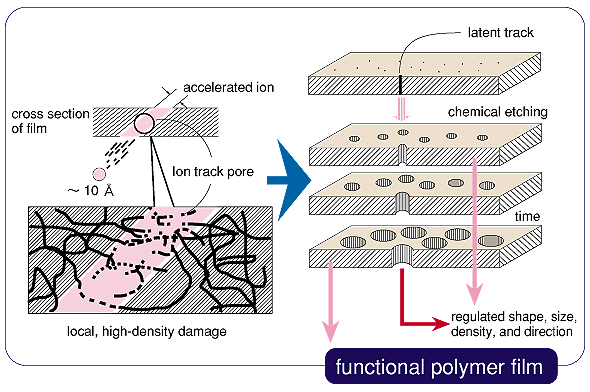
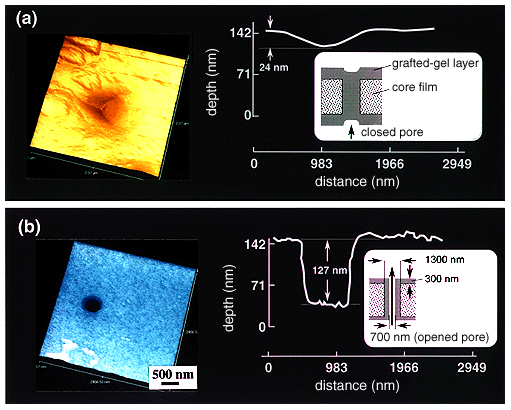
| By chemical treatment of latent tracks formed when energetic heavy ions pass through a thin polymer film we can synthesize a film with pores of regulated shape, diameter, direction and number density. If we further graft specific molecules onto the film thus synthesized, we have a film for selective transportation of specific molecules or with an on-off function of the environment responsive character such that opens and closes dependent on temperature, pH and so on. Application to various fields is expected such as artificial organs, drug delivery system (system ensuring the effective distribution of drugs in the organ) and separation of blood components etc. |
| Reference
M. Yoshida et al., Novel Thin Film with Cylindrical Nano-Pores that Open and Close Depending on Temperature: First Successful Synthesis, Macromolecules, 29(27), 8987 (1996). |
| Select a topic in left column |  |
|
Persistent Quest-Research Activities 1996 Copyright(c)Japan Atomic Energy Research Institute |