Matter consisting of protons, neutrons, pions and the like is
called hadron matter or nuclear matter. A well-known typical example
representing hadron matter is the nucleus, which has a spherical
shape of minute radius of a few fm (1 fm = 10-15 m), balancing nuclear forces and Coulomb forces and constrained
by the Pauli principle. It is well known that the density has
almost the same value for all nuclei, which is usually called
the saturation density denoted by rho0, and is uniformly distributed inside a nucleus.
As for macroscopic systems of nuclear matter, there exist neutron
stars and supernovae (a supernova shows up as the very first stage
of a neutron star in the process of its birth).
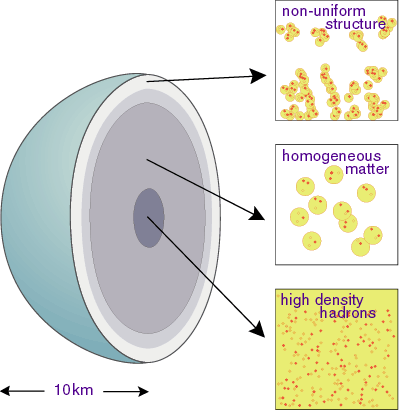
A neutron star is a celestial body of radius about 10 km made
up mostly of neutrons with a central density several times larger
than the saturation density, and with a much lower peripheral
density (Fig. 1-1). Low-density nuclear matter plays an important
role in celestial phenomena such as the process of supernova explosion,
exerting an influence upon the neutrino absorption process which
has a strong effect on the explosion strength and also an influence
upon the mutual interaction between nuclei and neutron superfluid
vortices, which is considered as one of the reasons for the variation
of the rotation period of a neutron star. The detailed mechanisms
of these phenomena are, however, as yet unknown.
Molecular dynamics, which is utilized for the study of microscopic
nuclear reactions, has the excellent feature that it enables us
to know the position and the momentum of each constituent particle
and it requires very few assumptions to perform calculations in
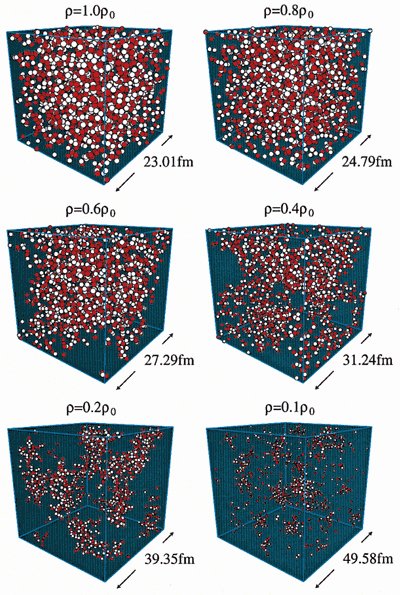
detail. Fig. 1-2 shows the ground state structure of nuclear matter
calculated by means of molecular dynamics. As the density decreases
to less than the saturation density, a non-uniform density distribution
develops leading eventually to a layer, cylindrical or spherical
structure. Although such a structural change has been already
expected in the past, this study, using molecular dynamics, reveals
new facts e.g. that the regularity of the structure is not always
complete or that small individual particles co-exist in the structure
and so on. One of the future aims of this study is to reveal the
structure of hadron matter in more detail and to investigate its
effect upon celestial phenomena |