It is well known that diatomic gas molecules such as nitrogen
and oxygen transform into insulating solids under high pressure
and, as the pressure is further increased, such molecular solids
become metallic, conducting electric current. Among these diatomic
molecules, oxygen is of particular interest because it shows magnetism
at low temperatures. After having metallized oxygen at pressures
exceeding 100 GPa (about 1 Mbar), we lowered the temperature to
near absolute zero (-273 degrees) and examined whether metallic
oxygen becomes superconducting or not. At last we discovered that,
at pressures of around 100 GPa and at temperatures below 0.6 K,
oxygen becomes superconducting.
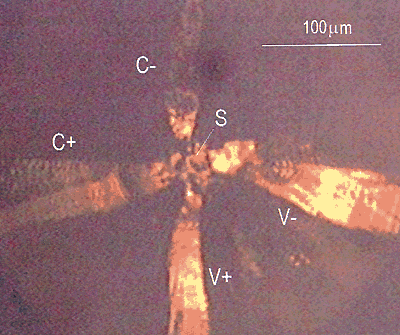
Figure 1-3 shows an enlarged photograph of the metallic oxygen
sample and the platinum electrodes for the electrical resistance
measurement at very high pressure, which was taken through a diamond
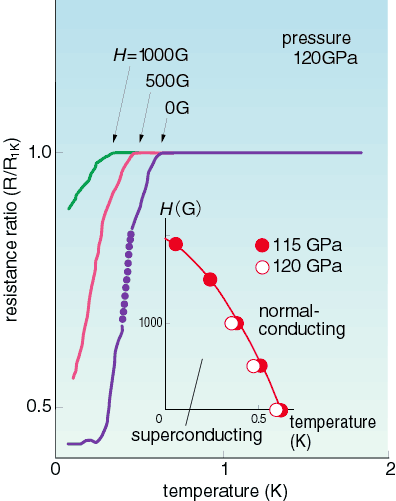
window. Figure 1-4 shows the resistance ratio (R/R1K) of oxygen as a function of temperature with the external magnetic
field Has a parameter. If we take the case of H=0 as an example, the resistance ratio decreases abruptly at a
temperature of 0.6 K, indicating that the transformation to the
superconducting state has occurred. The resistance ratio below
0.6 K is from a part that is nonsuperconducting. This part is
due to some pressure distribution in the sample, which is inevitable
under the present extreme environment. The inset shows the critical
magnetic field versus transition temperature, which characterizes
the superconductivity. In addition, we confirmed the superconductivity
by observing the Meissner effect of expelling magnetic flux lines
from the sample.
We have already found that sulfur becomes superconducting at very
high pressure. Both oxygen and sulfur belong to the VIb series
in the periodic table, however, they are very different in superconducting
transition temperature: oxygen and sulfur become superconducting
at 0.6 K and 15 K, respectively. It is conceivable that, in the
case of oxygen, magnetism suppresses the appearance of superconductivity.
These results are the latest frontiers in the field of very high
pressures and extremely low temperatures. |