 |
|||||
|
|||||
 |
|||||
|
|||||
| Nuclear magnetic resonance (NMR) spectroscopy, which observes
microwave absorption by nuclei having nuclear spin in an applied
magnetic field, provides useful information on the local electronic
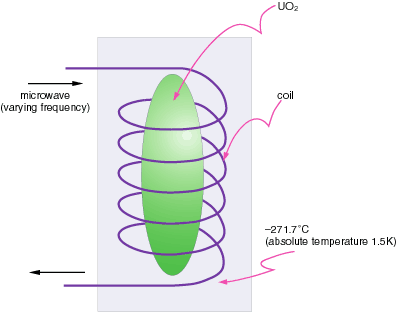
configuration around the nuclei. Actinide elements with 5f-electrons reveal various unusual electric and magnetic properties, e.g. anisotropic superconductivity and have now become widely studied. The NMR experiments have been difficult because the 238U nuclei, which amount to 99.3% of natural uranium, have no nuclear spin and the 235U nuclei with nuclear spin of 7/2 have only a poor natural abundance of 0.7% and also a weak sensitivity. We have prepared a highly (93%) 235U enriched and sintered sample (1 g) of UO2 having its exact stoichiometry (U/O=1/2). It is known that UO2 below 30.8 K (Neel temperature) is in the antiferromagnetic state where magnetic moments of neighboring uranium atoms are aligned antiparallel. The NMR experiments in the antiferromagnetic states were carried out at 1.5 K and seven resonance lines, as expected from the 235U nuclear spin, have been clearly observed. As NMR spectroscopy gives us much information about the environment at the probe nucleus, it is expected to become a powerful tool in the material science of actinide compounds. |
| Reference K. Ikushima et al., Observation of 235U NMR in the Antiferromagnetic State of UO2, J. Phys. Soc. Jpn., 67 (1), 65 (1998). |
| Select a topic in left column |

|
|
Persistent Quest-Research Activities 1998 Copyright(c)Japan Atomic Energy Research Institute |