 |
|||||
|
|||||
 |
|||||
|
|||||
| The cyanoethyl group attached to the chiral carbon atom and bonded
to the cobalt atom in a cobaloxime complex which is known as a
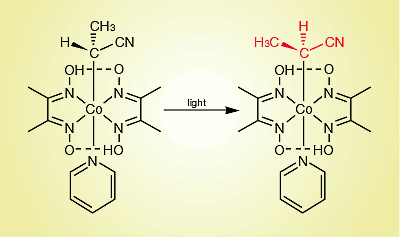
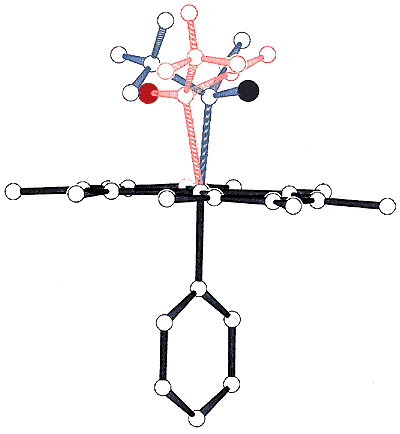
model molecule of vitamin B12 may be inverted to the opposite configuration by a chemical reaction
with molecular rearrangement. This inversion reaction occurs even in the single crystal form on exposure to visible light without degradation of the crystallinity. The chiral carbon is bound to four different groups, namely hydrogen (H), methyl (CH3), cyano (CN) and cobalt (Co), and for the reaction (racemization) to take place there are two possible processes: (1) cleavage of the Co-C bond and (2) cleavage of the H-C bond followed by H-atom transfer from the methyl group. To discriminate between these possibilities we employed neutron diffraction. Neutron diffraction is especially useful for the determination of the position of light atoms, compared with X-ray diffraction which is sensitive to heavy atoms having many electrons. We prepared a single crystal (3*3*0.6 mm3) of the cobaloxime complex having the cyanoethyl group CH3C(D)CN as one of the ligands. Here, an H-atom bonded to the chiral C is replaced by a D-atom. The crystal, irradiated with a fluorescent lamp for 36 h, was analyzed by a neutron diffractometer using a neutron beam (wavelength: 1.06 angstrom from the JRR-3M reactor of JAERI to determine its molecular structure, e.g., the position of the H and D-atoms. The results show that the inversion reaction proceeds while the D-atom does not exchange with the H-atom in methyl group (CH3). Thus, we concluded that the reaction begins by cleaving the Co-C bond to produce a cyanoethyl radical, followed by its rotation and recombination with the Co atom to form a cyanoethyl group with the opposite configuration. |
| Reference T. Ohhara et al., Direct Observation of Correlation between Crystalline-State Deuterium Transfer and Racemization of 1-Cyanoethylcobaloxime Complex by Neutron Diffraction, Chem. Lett., 4, 365 (1998). |
| Select a topic in left column |

|
|
Persistent Quest-Research Activities 1998 Copyright(c)Japan Atomic Energy Research Institute |