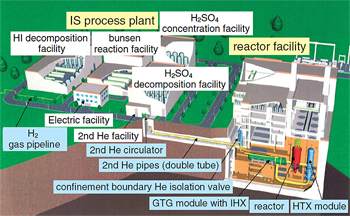
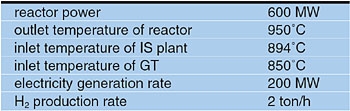
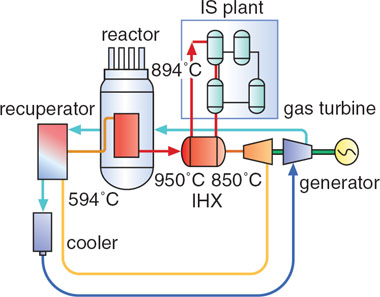
The conceptual design (Fig.1-1) of the Gas Turbine High Temperature Reactor 300 for Cogeneration (GTHTR300C), which will be a CO2 emission free VHTR to be deployed in the 2020s aiming at producing hydrogen (H2) and generating electricity, has been completed. It will be a highly efficient and economically competitive VHTR system with a thermal power of 600 MW and an outlet temperature of 950 degree Celsius connected to a H2 production plant and an electricity generation plant (Table1-1). The Intermediate Heat Exchanger (IHX) and the Gas Turbine (GT) are installed in series in the primary circuit so helium (He) over 900 degree Celsius can be efficiently used for H2 production, and He at 850 degree Celsius can be used for generating electricity (Fig.1-2). The net reaction of the Iodine-Sulfur (IS) process converts heat from the reactor and water to yield H2 and O2. R&D is progressing to meet the goal that the energy used to produce H2 will be approximately 45% of the heat transferred to the H2 production plant. Upon achieving this goal, the efficiency of H2 production will be 20% higher than that of a Light Water Reactor coupled to an electrolysis plant. Electricity will be generated by the GT installed directly in the primary circuit. Since the GT is driven by 850 degree Celsius primary He gas, the efficiency of the generation of electricity will be ca. 45%, which is more than 10% higher than that of a LWR with a steam cycle.
In addition, independent operation for H2 production or generation of electricity can be available. With the H2 production option, the outlet primary He gas will remain at 950 degree Celsius with decreased reactor power, and the GT will circulate the primary He gas. With the generation of electricity option, the reactor outlet temperature will be lowered to 850 degree Celsius without exchanging heat in the IHX.
The GTHTR300C design is based upon reactor technologies obtained from the design, construction, and operation of Japan's first HTGR, the High Temperature Engineering Test Reactor (HTTR), material and structural technologies developed for the IHX, technologies to be developed for the IS process, a GT compressor, and a magnetic bearing to minimize development risks. Due to these matured technologies, deployment earlier than the other similar systems in the world is possible. This study is entrusted from the Ministry of Education, Culture, Sports, Science and Technology.
|